The Carrington flare of September 1st, 1859 is likely by far the largest solar flare observed so far. But is it the largest flare the Sun can unleash? Indirect evidence suggests superflares may happen a few times in a millennium. Is there a looming space weather threat that eclipses even the Carrington event?
What are stellar superflares?
Stellar superflares are massive releases of pent up magnetic energy on the surfaces of stars. Their driver is the same as in solar flares – release of energy through magnetic reconnection. But the total energy release output is enormous – from 1033 to 1038 ergs (1026 to 1031 Joules). This makes them up to 10 000x more powerful than even the largest directly observed flares on the Sun.
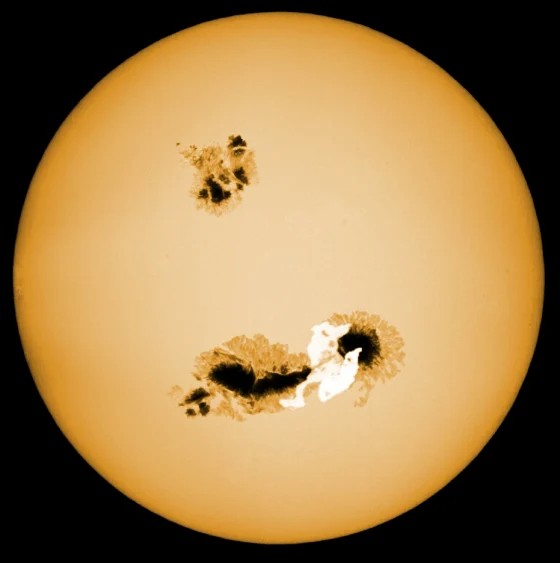
Artist’s impression of what a stellar superflare might look like. Credit: Hiroyuki Maehara, Kyoto University.
Superflares are known to be magnetic reconnection events in powerful magnetic fields of stellar spots. There is no mass transfer or thermonuclear explosions like in novae, dwarf novae or micronovae. This is known because: 1) superflares often happen in single-star systems while the other three phenomena only happen in binary star systems, 2) superflares do not show Doppler-shifted absorption/emission lines of rapidly expanding ejecta, 3) superflares show exceptionally fast rise times, followed by exponential decay typical matching known mechanisms in solar flares, different from novae, dwarf novae and micronovae. Superflares are essentially ‘just’ gigantic versions of solar flares that we are used to.
Superflare X-class scale
A flare energy of 1033 ergs corresponds to an ~X100 solar flare, 1034 ergs to ~X1000. Extreme superflares in 1035-1036 would correspond to ~X10 000 – X100 000 flares. The largest instrumentally observed solar flare, the November 4th, 2003 X45 event released ~4-5 x 1032 ergs of energy. New estimates of the Carrington flare suggest it may have approached the lower bound for superflares.
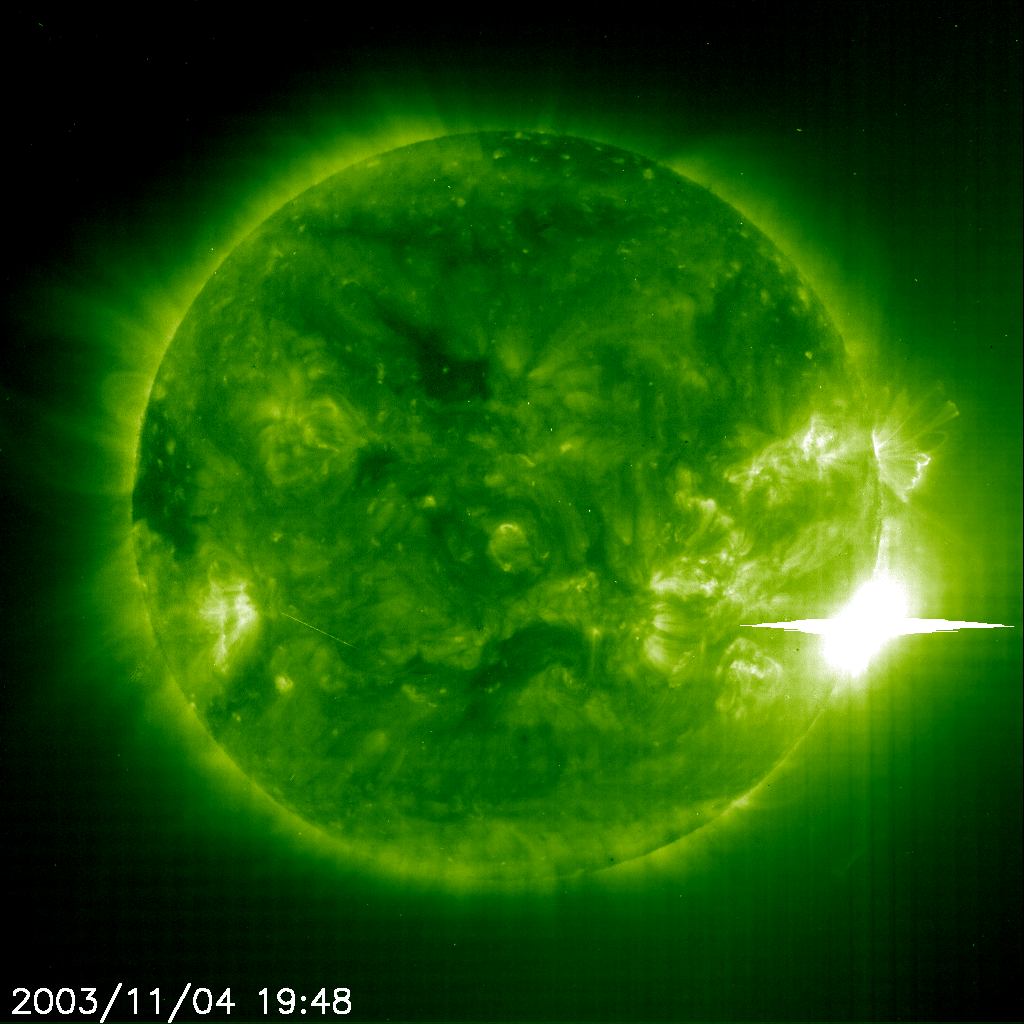
The largest instrumentally observed solar flare: the November 4th, 2003 ~X45 event on the western limb. Image: SOHO/EIT (ESA & NASA).
Big flares, big stellar spots?
Stellar flares are releases of magnetic energy through magnetic reconnection in complex and powerful magnetic fields of stellar spots. The amount of pent up energy in the magnetic field broadly scales with the size (area) of the stellar spot (active region).
A 1033 erg (~X100) superflare would require a stellar sunspot covering at least about 0.1-0.5% of the stellar disk. For 1034erg (~X1000) and 1035-1036 erg (up to ~X100 000) superflares the general minimum areas are ~0.5-2% and ~5-10%, respectively.
How frequently do superflares occur in Sun-like stars?
We have never seen a superflare on the Sun. But we have observed many, many Sun-like stars and that gives us an idea of how often superflares may occur on the Sun. The Kepler space telescope monitored about 100 000 Sun-like stars in its primary 4-year mission (2009-2013). The accumulated observations are equal to observing the Sun for about 200 000 to 300 000 years.
Superflares are frequent on rapidly rotating, young Sun-like stars, with rotation periods of up several days. Such stars experience superflares from several times a day to once every few weeks. They are far more rare on slowly rotating Sun-like stars (rotation period 20 days or more). An ~X1000 flare might happen on such a star approximately once every 100 to 1000 years.
Is there evidence for past superflares on the Sun?
The Sun has not produced a superflare during the era of modern satellite and telescopic observations. But indirect geological evidence may be used to search for past extreme Solar Particle Events, linked to superflares, further in the past.
Solar Particle Events (SPEs) are intense blasts of high-energy charged particles, mostly protons, from the Sun. They are caused by strong solar flares and coronal mass ejections. When high-energy protons hit nitrogen atoms (14N) high in the atmosphere, they convert it into radiocarbon (14C). Extreme bursts of high energy solar particles produce large amounts of radiocarbon. As trees absorb carbon dioxide during the growing season, they lock the pulse of radiocarbon into the specific annual tree ring.
While analyzing radiocarbon content in subfossil wood, physicist Fusa Miyake found a large spike in- the years AD 774-775. This was the first Miyake event. Further similar spikes – Miyake events – were found in 7176 BC, 5259 BC, 664 BC, and 993 AD. The largest Miyake event happened around 12,350 BC (also called the “Late Glacial Event”). There are also unconfirmed events in 5628 BC, 5410 BC, 1052 AD, and 1279 AD.
The high-energy particle bombardment of the atmosphere also produces radionuclides like Beryllium-10 (10Be) and Chlorine-36 (36Cl). They are preserved in ice on Greenland and Antarctica and found in ice cores. They provide independent confirmation of Miyake events. There are currently 6 confirmed Miyake events and an additional 4 unconfirmed. It is likely that as more research is done and more data becomes available, further Miyake events will be found.
Single solar superflares or clustered barrages?
The surges in radiocarbon and radionuclides in Miyake events point to extreme solar storms. Yet it is currently unclear whether the geochemical spikes are the result of a single colossal solar superflare or a sustained barrage of extremely large flares lasting months and perhaps more.
But detailed work on radiocarbon trapped in tree rings is shedding new light on this question. A Korean research team was able to narrow down the 774-775 AD Miyake event to between late April and mid-June in 774 AD. That leaves just a two-month window. A major flaring active region would make two rotations in that time. That is a short time window. Even if it was a barrage of intense flares, they would need to be very intense and very frequent. The enormous Carrington event does not even register in the geochemical record. To match the radiocarbon production of the 774 AD Miyake event, an active region would need to blast a large number of super-Carrington flares in only a few weeks. Or the 774 AD event may well have been a single solar superflare in the ~X500 or higher range.
On the other hand, the 664/663 BC Miyake event was much longer, and likely caused by multiple consecutive solar storms over 2–3 years.
What would the effects of a superflare be?
A solar superflare could be the most devastating event in recent human history. Here is the worst case scenario. Our modern society would basically be reset to analog times. With widespread destruction of high-voltage grid transformers, cities and societies would immediately face life-threatening shortages of running water, food, sanitation and medical supplies, as supply chains collapse. Digital banking, communications, and global markets would collapse and disappear overnight. It would force economies to go back to bartering and government-mandated emergency rationing. Rebuilding the power grid would take years while the world would go back to the early 19th century way of living.
Certainly an event we as a society need to be prepared for.