The Perseid meteor shower is making the headlines, and for a good reason: their return in 2026 is one of the best in years. The moon is out of the sky, leaving dark skies for observers to fully enjoy the celestial fireworks. So what’s happening and what to do so you don’t miss it? Here is my advice after three decades of observing this meteor shower.
What are the Perseids?
The Perseids are little crumbs of comet 109P/Swift-Tuttle that hit our atmosphere at about 60 km/s (per second) and burn up about 80-110 km high. The crumbs, also called ‘meteoroids’, are loose chunks of mineral grains form the comet that are no stronger than cigarette ash. Even the bigger ones, the ones that cause bright meteors, have no chance of surviving their fiery plunge.
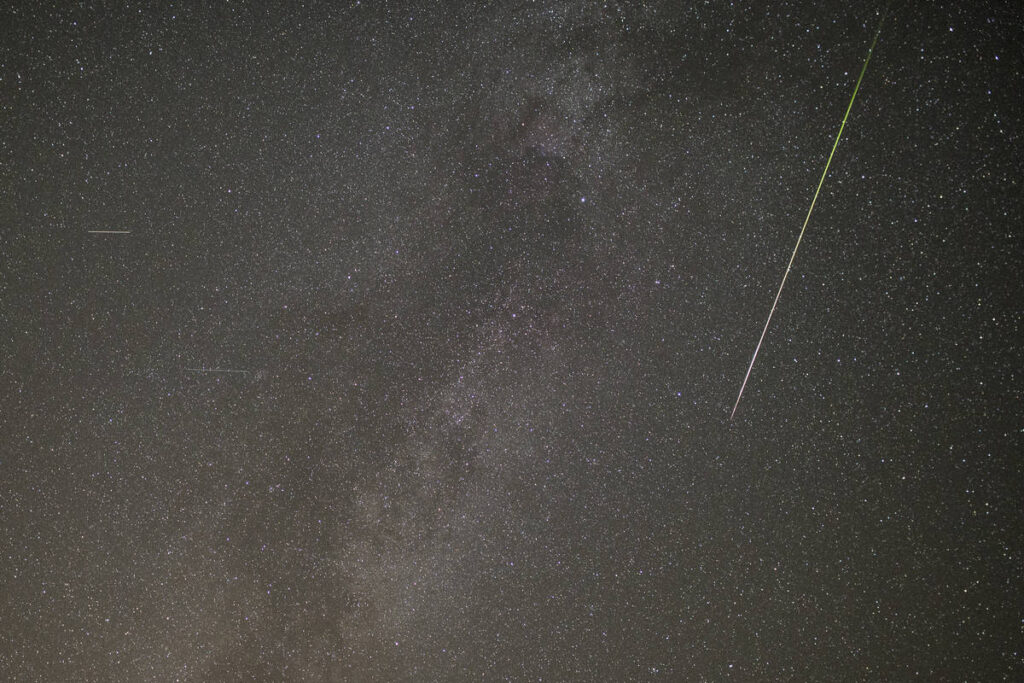
A bright Perseid shoots along the Milky Way in the constellation Cygnus. August 12th, 2015. Photo: Jure Atanackov.
By the way, comet Swift-Tuttle will pass close to the Earth in 2126, potentially becoming a very bright naked eye (Great) comet. Just in case anyone wants to update their calendar.
Over the centuries the comet spread a wide and dense stream of tiny dust crumbs, called a meteoroid stream. We pass it every year at the same time in early August and see it as the Perseid meteor shower. The meteors appear to fly out of the constellation Perseus, hence their name – the Perseids.
Perseid meteors are swift, colorful and often bright, and they often leave a brief wake.
Perseid peak and rates
This year the Perseid meteor shower peaks on August 13th at 2-4h UTC. The timing favours Europe and Africa, especially the western parts. Expect the highest rates then, but the peak is broad enough for the entire world to get a fine show. So don’t worry if the peak is during daytime at your location.
In fact, the Perseids are worth watching at least a few nights before and after the peak. In 2026 the pre-peak nights are under the rapidly diminishing influence of a waning crescent moon. On August 9th a 14% illuminated crescent is located in Gemini, rising around 1:30 am and barely brightening the predawn sky. By the next night it is down to 7% illumination, rising around 2:30 am and having virtually no effect. The peak night is, of course, moon-free with it just having performed a total solar eclipse!
Expect about 15-20 Perseids per hour in the final predawn hours on August 8-10th, ramping up to 30/h on the 11th and 40-50/h on the 12th. The rate on the peak night will likely be about 60-90 meteors per hour, depending on conditions.
Fireballs!
The Perseids are well-known for their colorful fireballs. If you observe for at least several hours on the peak night, let alone if you do a full allnighter, you will likely see a brilliant Perseid as bright as Venus or brighter.
In fact, the brightest Perseid I’ve seen in my 30 years of observing the shower was in the pre-peak morning: a brilliant blue -10 magnitude meteor in the southeastern sky. The flash lit up the sky and ground, the many observers around me erupted in excited shouts and cheers!
Perseid fireballs are also known for the persistent train they leave behind. They can last tens of seconds or even a few minutes. Bring binoculars to see them snake across the starry background.
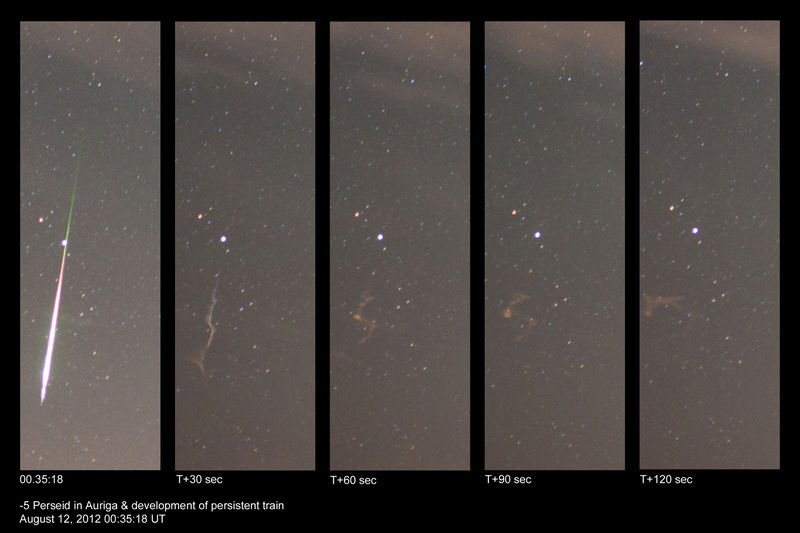
Persistent train after a -5 magnitude Perseid (about as bright as Venus) on August 12th, 2012. Photo: Jure Atanackov.
When and how to see the Perseids
Meteors are super fun to observe. You need no special equipment: just your eyes. Don’t use binoculars or telescopes, as they have too limited fields of view. You need to see as much of the sky as possible. I prefer open meadows or mountain peaks that offer a 360° unobstructed view. Find dark skies, as dark as you can – light pollution eats up meteors. I would aim for at least Bortle class 4 skies or preferably better.
A reclining chair or a mat will do wonders to keep you comfortable. Observing standing up and cranking the neck works for a little while, but becomes uncomfortable and painful. Dress warm! It is summer, but the nights still can get cold, especially if you are mostly still for hours. Bring plenty of snacks and drinks (non-alcoholic, or you may have trouble distinguishing between ordinary and shooting stars, really!).
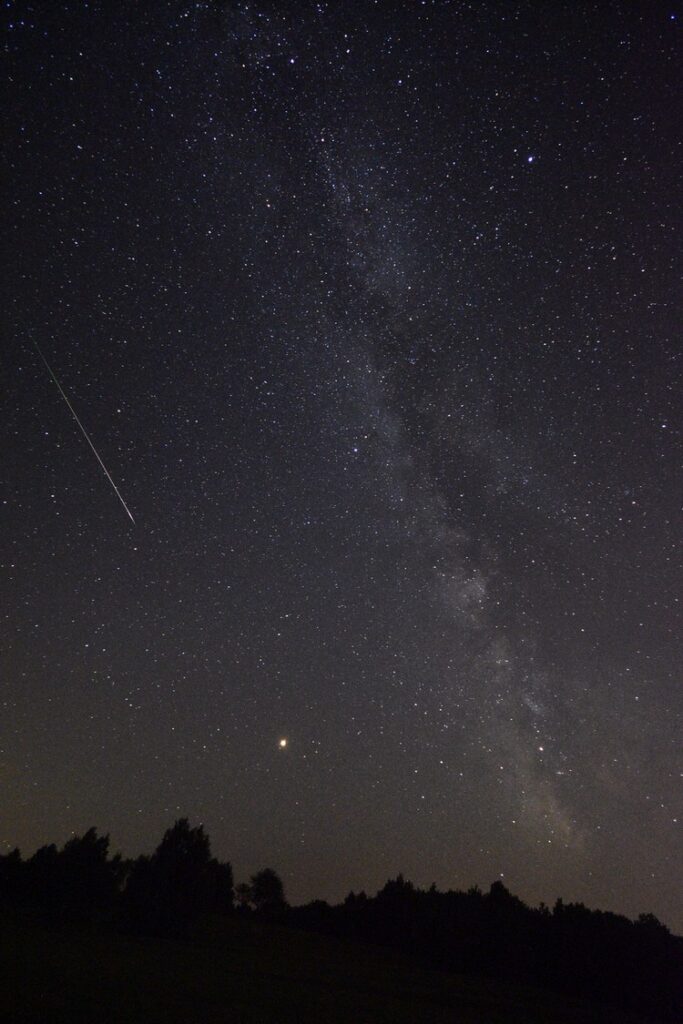
Bright Perseid and the Milky Way. August 12th, 2018. Photo: Jure Atanackov.
In mid-northern latitudes the Perseids are visible throughout the night. With a bit of luck you will spot meteors even in a bright twilight sky. The rates are the lowest in the evening and increase through the night by about 2x.
You may enjoy solitude under the calm and warm summer skies. Just make sure to let people know where you are going. I like to observe in company, the chatter and shared excitement with other observers is awesome!
Not just the Perseids!
As you watch the skies you will quickly note that there are more meteors than just the Perseids. There is a number of meteor showers with lesser rates active during the Perseids: the Delta Aquariids, the Kappa Cygnids, the Alpha Capricornids, other showers and of course the random, sporadic meteors. You will see the steady succession of Perseids occasionally punctuated by a slower meteor going in a completely different direction. The Kappa Cygnids and the Alpha Capricornids are known to produce occasional bright fireballs, spicing up the show.
Good luck and clear skies!
If you decide to go under the sky and watch the Perseids, know that there will be many thousands of observers across the world watching the same show. We will all be enjoying nature’s fireworks together as comet crumbs light up the sky above us.
Good luck, see you under the stars!