There is a unique chance for observers of the upcoming total solar eclipse on August 12th to spot a bright meteor from the Perseids during totality. Total solar eclipses are rare, but far more rare are eclipses coinciding with major meteor shower peaks. This is an exceptional chance!
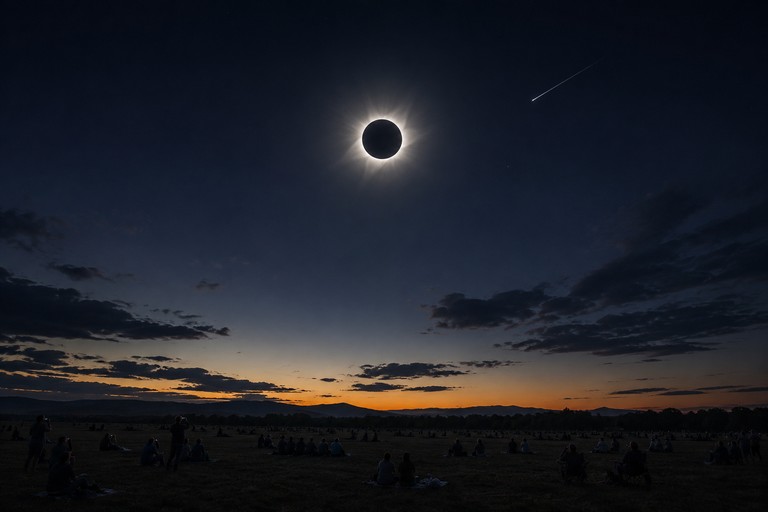
AI-generated view of what a bright meteor during totality may look like.
A unique and incredibly rare timing
There is only a single other occasion in the last 150 years when a total solar eclipse occurred within about a day of the Perseid peak: the August 11th, 1999 total eclipse.
I saw that eclipse. I did not see a Perseid meteor in just under the 2 minutes of totality. But I also did not look for Perseids, being fixated on the solar eclipse. The total eclipse is a captivating sight, looking around the darkened sky to see a meteor is almost (but just almost) a waste of precious time.
Still, observers may chance into a bright Perseid while they take in the darkened sky and the twilight ring around it. So how likely will it be to see a Perseid meteor during totality?
What are the odds?
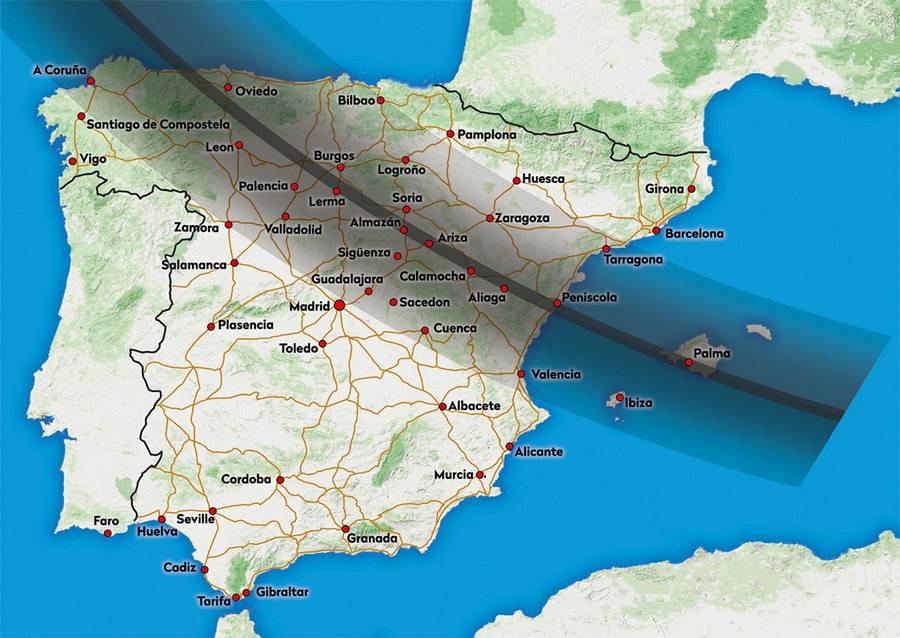
This is a scenario for Spain, which currently seems the best place to see the eclipse. Totality happens in the late afternoon, with the Sun low in the western sky.
On the central line near Peñíscola the Sun will be 4° above the W horizon during totality. The Perseid radiant will be about 7° above the N horizon. The meteor shower will likely be close to peak rates, so we can assume ZHR~80 meteors per hour.
Adjusting for the radiant height, the actual rate for this location will be around 10 meteors per hour. That’s on average less than one meteor under dark skies during the just under two minutes of totality. Additionally, the rate is calculated for a dark night time sky, not the essentially twilight sky during totality.
Conditions will be significantly better in Iceland, with the Perseid radiant at 29° altitude during the somewhat longer totality. The chances of seeing a Perseid during totality will be about 10x better than in Spain.
Catching a Perseid during totality
The odds of actually seeing a Perseid during totality are low, especially as observers will be looking at the eclipsed sun most of the time. But if you have a spare camera and a wide field or fisheye lens, crank up the ISO, shorten the exposure and let it hunt for Perseids. You might be lucky and catch one. How great would that be?!
To all observers: good luck and clear skies!