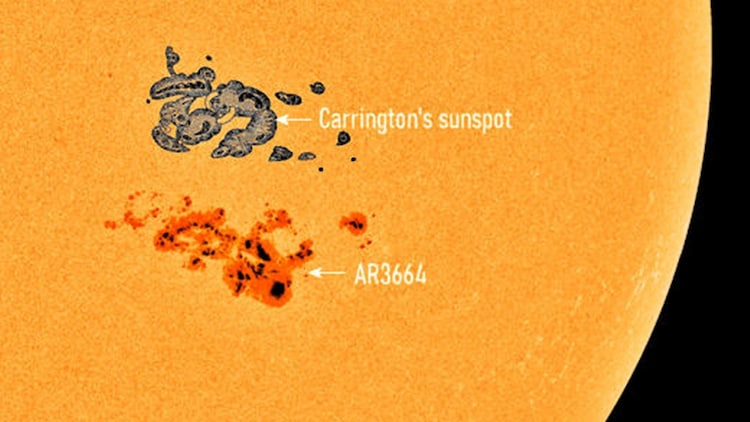
When people speak of the Carrington Event of 1859, they usually recall the dramatic solar flare observed on September 1st and the immense geomagnetic storm that followed. Just three days before the legendary Carrington storm, on 28 August 1859 the Earth was struck by another great geomagnetic disturbance — itself a century-level event. Overshadowed by its infamous successor, this earlier storm deserves recognition in its own right. By some measures, it ranks among the top five geomagnetic storms of the past 500 years..
The late August storm began in the evening of 28 August, coinciding with a new moon — perfect viewing conditions. The sky across Europe, North America, parts of the Southern Hemisphere erupted in spectacular, exceptionally bright and dynamic auroras. Brilliant red Type A aurora spread far equatorward, deep into the mid-latitudes and even well into the low latitudes. Modern reconstructions estimate the storm reached a minimum Dst index of −673 nT, making it stronger than nearly every recorded storm since, except the September 1859 superstorm and a handful of others.

Great red Type A aurora during the 2003 Halloween G5 storms. 30 October 2003, view from Kamnica, NE Slovenia (45°N MLAT). Photo: Jure Zakrajšek.
Aurora spectacle
Contemporary observers recorded vivid descriptions of bright and dynamic aurora displays across many parts of the world, records that both awe and alarm. The auroral light was so bright that in some places people thought large fires were burning. Some reports from the UK, France and the US said the aurora was bright enough to read a newspaper outdoors at night!
Reports from Europe
Long auroral displays were recorded across Europe – including in Portugal, Italy, Spain, Ireland, Greece, and Russia—with instances of the lights extending beyond the zenith. In Great Britain and Ireland the aurora was brilliant, with crimson and green dominating the sky. Observers described “blood-red curtains” stretching overhead. In Paris the bright red aurora was initially mistaken for a massive city fire, drawing crowds and alarming the public. Brilliant displays were seen as far south as Rome and Athens, a corona display was seen far south in Lisbon.
London, England: “At 0:15 AM on August 28th the auroral light in the north assumed the form of a luminous arch, similar to daybreak, and in the southwest there was an intense glare of red covering a very large extent of the sky. At 00:20 AM streamers appeared; at 00:25 AM the streamers rose to the zenith and were tinged with crimson at their summits. At 00:45 AM frequent coruscations appeared in the aurora. At 01:20 AM the arch which had partially faded began to reform and the body of the light was very strong but not bright enough to read newspaper print. At 1:30 AM the light had begun to fade. By 2:00 AM the aurora was very indistinct.“
Madrid, Spain: “Aurora borealis. From eleven thirty to one thirty in the night of Sunday, there glowed on the horizon a magnificent aurora borealis, which presented a long strip of fire running from west to east. The rarity of these events in our zone means that whenever they occur they cause the admiration of everyone who sees them. Since 1848, no other aurora had been observed in Madrid”.
Numerous observations of great aurora were made at sea further west over the Atlantic, reports gathered by Rear-Admiral Robert Fitz Roy of the British Navy. In the north Atlantic (50°47’N, 10°12’W) “… the sky being cloudy, it brightened up like daybreak, remained so for twenty minutes, then turned a dark red, and soon after darkened in again as before“. Further south in the Atlantic (29°48’N, 45°20’W) “… the aurora was seen from 9 p.m. till 4 a.m. the next morning, of a rose color. Streamers about 30° high.“
Reports from North America
In North America auroras were seen as far south as Florida and New Orleans. But they extended even further south into Central America in Cuba, Jamaica and even Panama!
Cleveland, Ohio: “Objects at a distance could be more readily and clearly distinguished than when the moon is at its full. Now vivid arrows of light of most exceeding brilliancy shot up from the whole northern horizon; and, retreating, would again shoot higher and higher, until they covered the whole sky. This continued to grow darker, first to scarlet, then to crimson, and finally to the blood-red like appearance of an immense conflagration. The whole sky appeared mottled-red,the arrows of fire shooting up from the north, like a terrible bombardment, of which we could see all and hear none, while the stars of greater magnitude shone through like sentry lights…”
Galveston, Texas: “August 28 as early as twilight closed, the northern sky was reddish, and at times lighter than other portions of the heavens. At 7:30 PM a few streamers showed themselves. Soon the whole sky from Ursa Major to the zodiac in the east was occupied by the streams or spiral columns that rose from the horizon. Spread over the same extent was an exquisite roseate tint which faded and returned. Stately columns of light reaching up about 45 degrees above the horizon moved westward. There were frequent flashes of lightning along the whole extent of the aurora. At 9:00 PM the whole of the streaking had faded leaving only a sort of twilight over the northern sky.“
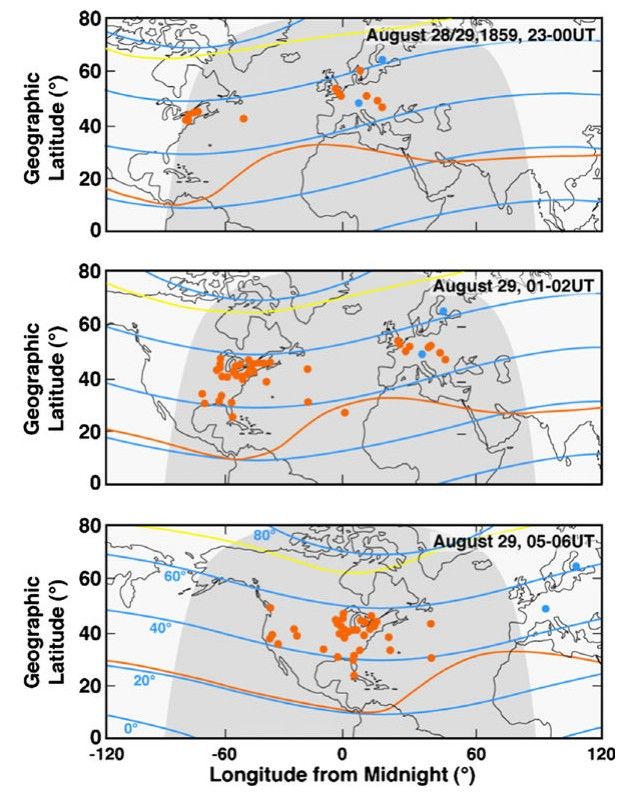
Eyewitness account locations (orange dots) and magnetometer stations (blue dots) of the great aurora on 28 August 1859. Different maps show selected time intervals from (Green & Boardsen, 2006).
A Global Phenomenon: From Europe to Australia
Brilliant aurora australis displays were also seen across Australia. At Sydney Observatory, “the southern sky glowed red like sunrise. A red arch from ESE to WSW appeared, with radiating streams brighter and lighter red.” Over Ballaarat, the aurora “formed a magnificent arch in red, green, and violet. Rays distinct and beautiful; illuminated the southern sky long enough to cast shadows.” And at Cape Otway (Victoria), observers described a “most magnificent Aurora Australis” from 6:30 p.m. until after 2 a.m., forming a broad rainbow-like arc 60–70° high, with shifting bands of blue, green, yellow, and deep red, the whole display flickering like the opening of a lady’s fan. Such dazzling accounts reveal that the storm’s reach extended deep into the Southern Hemisphere. It produced auroras of rare brilliance and extraordinary colour at latitudes where they are seldom seen.
Technological effects
The 28-29 August 1859 geomagnetic storm is often overshadowed by the Carrington event, and the technological effects are less well known, but sill remarkable. The magnetometer at Kew Observatory in London recorded disturbances and abrupt swings so strong that, at times, the pens went off the paper scale. Similar violent fluctuations were observed at Greenwich and Prague. Rapid deflections and magnetic ‘jerks’ were also were also noted at Toronto observatory.
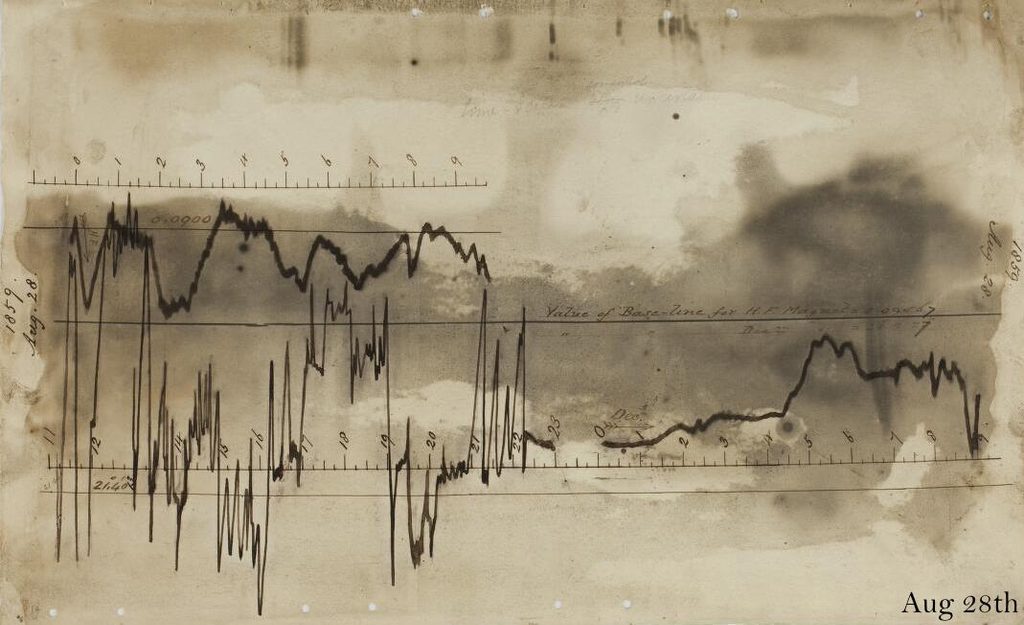
Greenwich Observatory (London) magnetogram on August 28th, 1859 showing strongly disturbed conditions during the intense geomagnetic storm. Image: British Geological Survey.
The intense geomagnetic storm produced widespread disturbances in telegraph lines across Europe and North America, the only long-distance electrical system then in use. Telegraph operators in Europe noted erratic currents and static discharges interfering with transmission. Messages were garbled or could not be sent at all during the peak of the storm. On the Washington-Philadelphia line it was reported that “the auroral current ran strong enough to work the line, but irregular and unsteady, so that communication was nearly impossible“. A Boston telegraph operator reported “messages could not be transmitted owing to strange currents. The wires were in constant agitation as if from a powerful storm“. Telegraph systems were also disrupted in Australia, making this a truly global disruption.
A warning from history
The 28-29 August 1859 geomagnetic superstorm without doubt ranks as one of the strongest in the past few centuries. It is one of only 20 geomagnetic storms in the last 500 years that pushed aurora into the tropics, to geomagnetic latitudes (MLAT) below 30°. Aurora reached extremely low geomagnetic latitudes down to ~25° MLAT during this event.
The minimum DST index (a measure of ring current intensity and global geomagnetic disturbance) of the 28-29 August 1859 geomagnetic storm was only recently estimated at -673 nT. Here is how it compares to some other great past storms:
- 28-29 August 1859 storm: -673 nT
- 1-2 September 1859 Carrington storm: below -850 nT
- 4 February 1872 great storm: below -830 nT
- 15 May 1921 great storm: ~-850 nT
- 13 March 1989 storm: -589 nT
- 29-30 October 2003 Halloween storm: -383 nT
- 10-11 May 2024 Gannon storm: -406 nT
A simple glance at these figures makes clear that the August storm, though overshadowed, was itself monumental — far stronger than the recent 2003 Halloween G5 storms and the 10-11 May 2024 G5 Gannon storm, both very intense storms in their own right. In fact, only three stronger geomagnetic storms have occurred in the 166 years since: the 2-3 September 1859 Carrington superstorm and the Carrington level storms on 4 February 1872 and 15 May 1921.
Were it not for the even stronger Carrington geomagnetic superstorm just 3 days later, the 28-29 August 1859 storm would be well known as one of the most intense in the last few centuries. In fact, by energizing the magnetosphere it likely helped contribute to the immense power of the Carrington superstorm, providing a running start for it.
We are overdue for the next one — and the modern technological society would be far more vulnerable than in 1859.