Imagine your sky filled with bright aurora for an entire night, from dusk until dawn. And the next night too. And the next one. For over a week. It may sound unbelievable, but it actually happened. This is the extreme aurora of 10-19 September 1770.
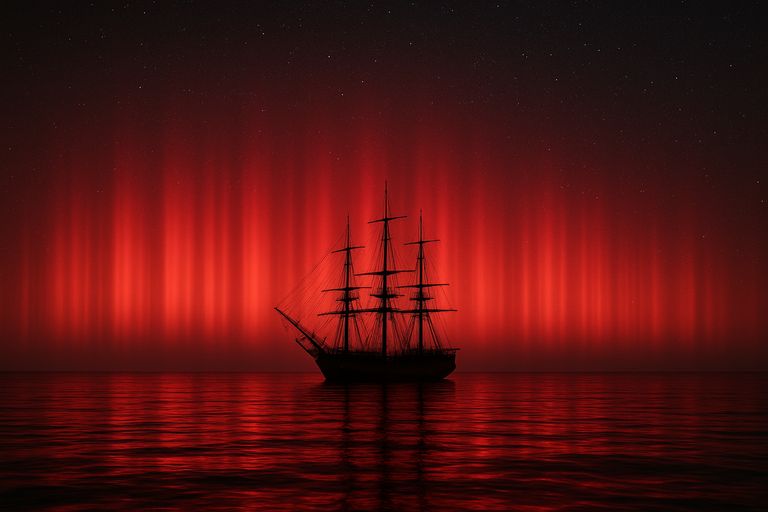
From 10 to 19 September 1770 aurora was recorded below 30° geomagnetic latitude (MLAT) in East Asian locations on each night except 12 September. Eight nights of aurora below 30° MLAT. For comparison in the entire 20th century aurora was seen below 30° MLAT in only 8 nights! The world saw a century’s worth of deep low latitude aurora in just over a week. The extreme aurora event took place near the peak of Solar Cycle 2, which peaked a year earlier in September 1769. With a peak smoothed sunspot number of 193, Solar Cycle 2 was slightly above average. Stronger than the current cycle and comparable to Solar Cycle 23.
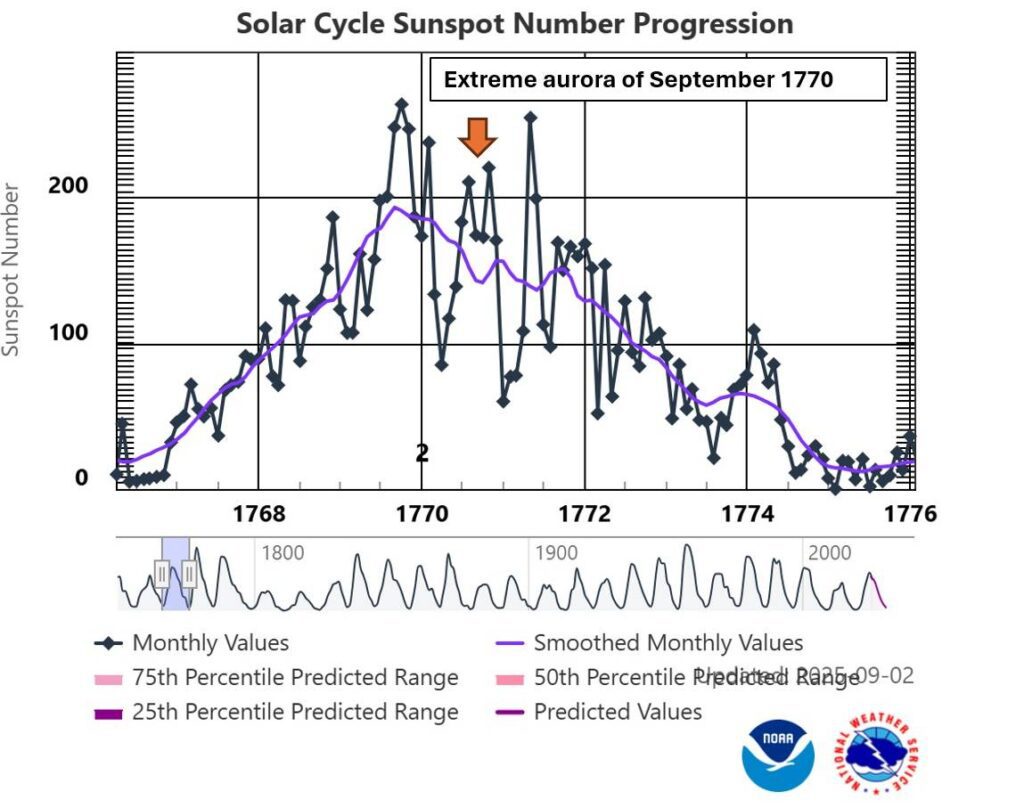
Solar Cycle 2 and the extreme aurora of September 1770 (SWPC).
An exceptionally large and complex active region, more than twice the size of that which caused the Carrington storm in 1859 was observed by contemporary astronomers. The size of the active region, estimated at ~6000 MSH points to an enormous solar flare potential. An active region of that size may be capable of solar flares in the X50-X100 range. That is larger than the Carrington flare (Shibata et al., 2013). And it was certainly more than capable of a series of a number of double-digit X-class flares with large, fast coronal mass ejections. The 9-day period of near-constant intense geomagnetic storming is indeed indicative of multiple, consecutive CMEs. Most of them were likely launched from the large active region.
Low latitude aurora spectacle
The first night of low latitude aurora is on 10-11 September 1770, when aurora was already sighted as far south as 24.5° MLAT. Only the following night was aurora not observed at low latitudes, but it returned on the 14th when it was again sighted at 24.5° MLAT. On 16 September 1770 Joseph Banks and Sydney Parkinson recorded aurora aboard Captain James Cook’s ship HMS Endeavour near Timor Island in the south Pacific at 21°S MLAT (Hayakawa et al., 2017). Crew members saw bright red auroras up to about 20° above the southern horizon.
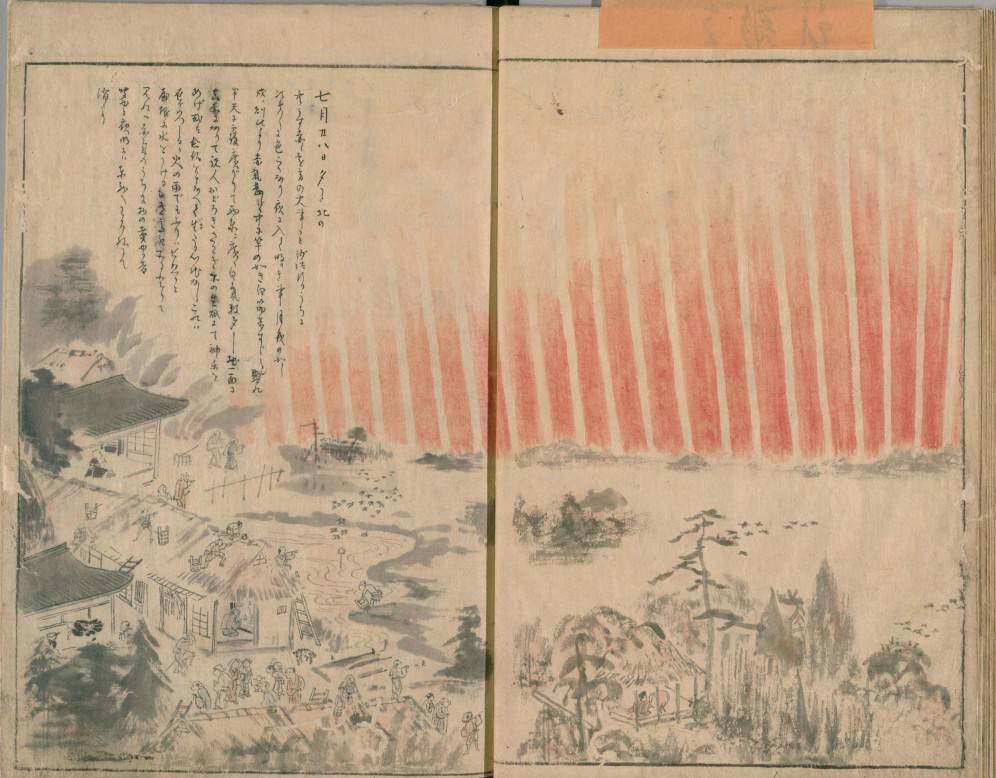
Drawing of red auroras over Japan in the September 1770 extreme aurora event (Hayakawa et al., 2017). Eyewitnesses recorded ‘blood-red skies’.
The geomagnetic storming peaked on 17 September 1770, when aurora was seen as far south as 19° MLAT (in Hunan, China)! That is deep into equatorial regions, only 19° from the geomagnetic equator. Not only was the extent of the aurora exceptional, it was also exceptionally bright (Ebihara et al., 2017). Even at 27-29° MLAT the reddish aurora reached up to the zenith, one record from China stating “red light crossed the heaven”. The extreme equatorward extent of the auroral oval underscores the truly exceptional intensity of the storm. The intense 10-11 May 2024 Gannon storm barely produced visible aurora low in the sky where the 17 September 1770 produced aurora overhead. The geomagnetic storm on 17 September 1770 was exceptionally intense. Modern reconstructions show it was at least as intense as the much more famous Carrington superstorm, and possibly slightly stronger (Kataoka & Iwahashi, 2017). The minimum DST index in the 17 September 1770 storm is estimated at approximately -850 to -1000 nT (Love et al., 2025).
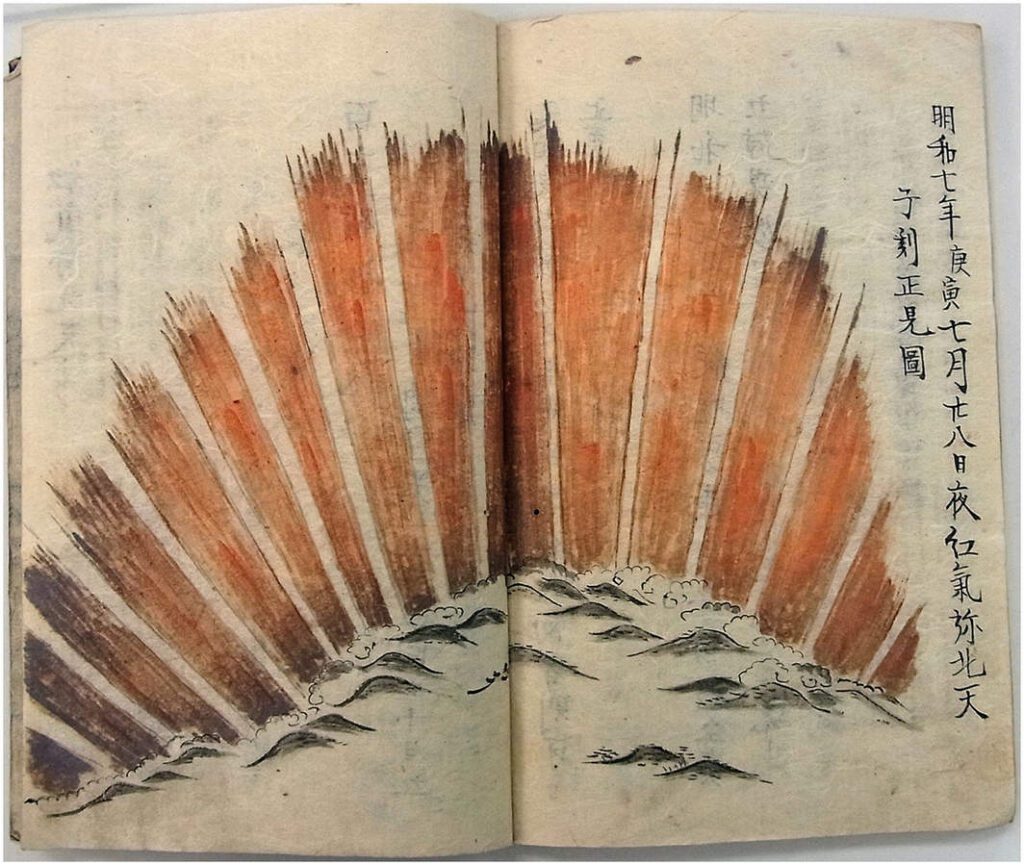
Drawing of red auroral rays over Japan in the September 1770 extreme aurora event (Hayakawa et al., 2017).
Even more aurora from the same active region?
Interestingly, this may have been the most intense in a longer period of hight activity. Low-latitude auroras with an approximate 27-day return period, equal to one Carrington rotation, were observed before and after September 1770. They were seen on 24-26 October 1769, 18 January 1770, and 15-16 October 1770. It is plausible that the same long-lived persistent active region was responsible for some or all of these active intervals. Or – perhaps more likely – multiple major active regions in the same active longitude interval.
Exceptional by any measure
The severe space weather period and low latitude aurora of 10-19 September 1770 is by far the most exceptional in the last five centuries. Not only did aurora reach deep into low latitudes, it did so nearly continuously for 9 nights! While we do not know the strengths of individual storms, even the weakest were likely at least about as strong as the 10-11 May 2024 Gannon storm. The strongest storm on 17 September 1770 was at least as strong as the Carrington event. The 10-19 September 1770 geomagnetic storm also demonstrates that a very large and highly active sunspot group / active region can produce extended periods of intense geomagnetic storming. Certainly a major historical reminder for a potentially increasingly vulnerable space age.