Here come the Halloween fireballs! This is a Taurid resonant meteoroid swarm return year any we may be in for a spectacle of bright meteors and fireballs. Here is how to see and photograph them.
Halloween fireballs occasionally make the news, dazzling astronomers and casual witnesses alike. Are the Taurids really that good? Yes! Analysis of observational data shows that usually the Taurid meteor shower produces up to some 7-8 meteors per hour and about 1% of shower members are fireball (Dubietis & Arlt, 2007). During resonant swarm return years the activity increases by 2x, possibly more, and the fraction of fireballs rises up to nearly 5%! This works out to a moderate meteor shower rich in bright meteors and fireballs. But maybe most importantly: Taurid resonant swarm returns are the only meteor showers (except possibly an exceptionally rare Leonid meteor storm) when you can reasonably expect to have a chance of seeing an exceptionally bright fireball.
Here are some of my thoughts about observing and photographing the Taurids having seen several resonant swarm returns.
Observing the Taurids
The Taurid radiant is almost directly opposite in the sky to the Sun. This means it rises at dusk, is highest around local midnight and sets at dawn. Taurids therefore appear throughout the night, with the highest rates around local midnight. When the radiant is low the meteors tend to be long, so early evening and morning hours are best for long fireballs. But fireballs and Taurid meteors overall will be most frequent when the radiant is at its highest, in the hours around local midnight.
When going out to observe the Taurids it is prudent to set expectations accordingly. This is not a major meteor shower like the Perseids and the Geminids. Even when rates are elevated the Taurids are more of a trickle than a shower. But many of the Taurids are bright and fireballs punctuate their display. It may take quite a bit of time until you see the first bright one and even more until the first fireball, so dress warm and be prepared to wait. But when the first big fireball appears it will have been worth the effort!

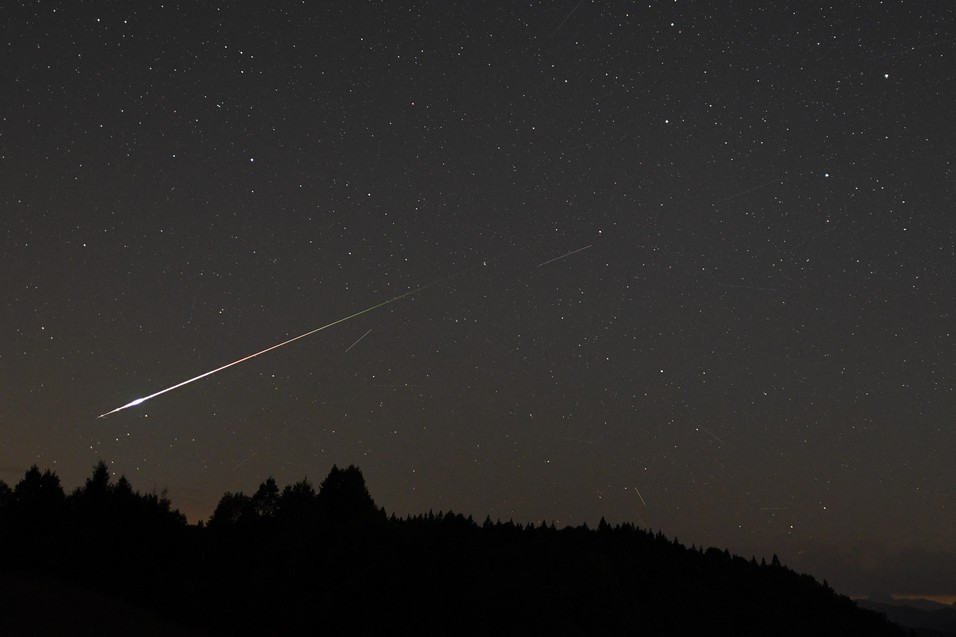
-4 magnitude Taurid fireball on the northern horizon on 2 November 2015. 24 mm f/2.8 lens, 15 seconds at ISO 3200. Photo: Jure Atanackov.
Estimating fireball magnitudes
Fireball brightness is estimated in magnitudes. This is a common measure of star brightness. The smaller the number, the brighter the star or any other celestial object. Each magnitude corresponds to about a 2.5x increase in brightness, so a magnitude 1 star is 2.5x brighter than a magnitude 2 star.
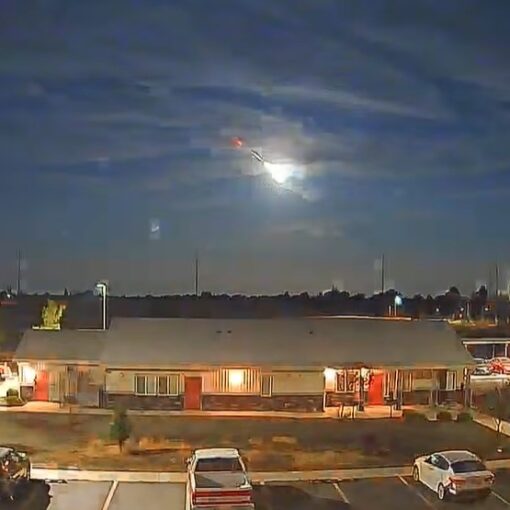
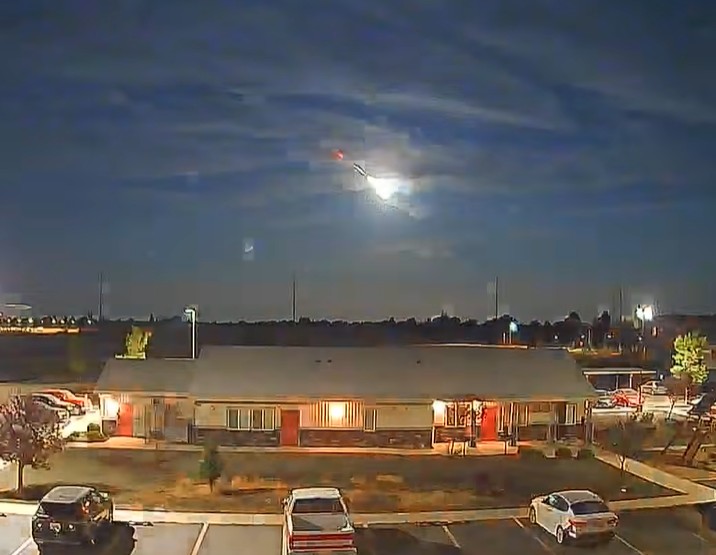
The International Meteor Organization defines a fireball as a meteor of magnitude -3 or brighter. There are no stars as bright, but the brightest planets are as bright as ‘low-end’ fireballs. Brighter fireballs are comparable in brightness to the Moon.
| Magnitude | Typical comparison (naked eye) | Visual impression |
| -3 | As bright as Jupiter. | Significantly brighter than the brightest stars. |
| -4 | As bright as Venus. | Much brighter than any star; easily noticed, even in twilight. |
| -6 | About 5x as bright as Venus. | Produces noticeable illumination of the ground, slightly brightens the sky in the immediate vicinity. |
| -10 | As bright as a Quarter Moon. | Produces significant ground illumination, illuminates the sky. |
| -13 | As bright as a Full Moon. | Produces strong ground illumination, strongly illuminates the sky. |
Photographing the Taurids
Photographing Taurid fireballs is somewhat different than photographing other meteor showers. For other showers we usually aim to capture faint(er) meteors as well as possible, using fast lenses, high ISO settings and shorter exposure times. For the Perseids for example, I usually go with f/1.4, ISO 6400 and 5 second exposures. Short exposures usually result in some meteors being truncated by the beginning or the end of the exposure. This is no problem as there are many meteors. But for Taurid fireballs we want to do it a bit differently.

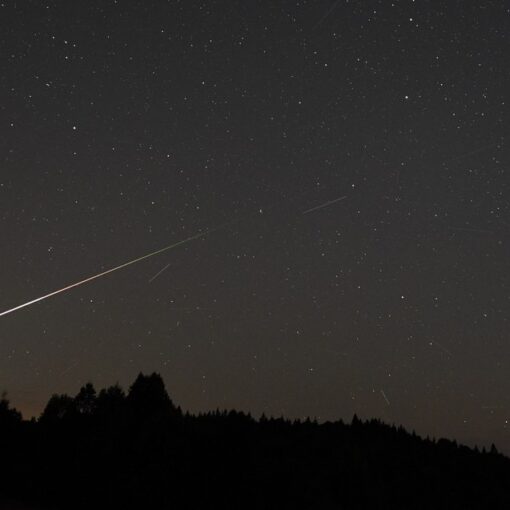
-3 magnitude Taurid fireball on 29 October 2022. 20 mm f/2 lens, 20 seconds at ISO 1600. Photo: Jure Atanackov.
For the Taurid fireballs we really do not want a meteor to be truncated by the beginning or the end of the exposure. Imagine a fireball brighter than the full Moon shooting through your camera field of view, only for the shutter to close midway through the fireball (been there, done that …). Therefore it is better to optimize for longer exposure even at the expense of sensitivity. A brilliant fireball will still be almost as brilliant, but it will less likely be chopped off by a short exposure. Of course, if you have very dark skies you can go with wide open aperture, high ISO and longer exposures.
Try to increase your sky coverage as much as you can. Use wide field lenses. If you can, operate more than one camera. For the 2015 and 2022 Taurid returns I ran up to 5 cameras and intend to do so in 2025 as well. Keep the horizon in the photo, many fireballs appear close to the horizon.
Recap – visual observing:
- Taurids appear throughout the night, they are most numerous in the hours around midnight.
- Expect moderate activity, with numerous bright meteors and occasional bright fireballs.
- Be under the sky for at least a couple of hours or more, to maximize the chances of seeing bright fireballs.
- Be out under the stars even if the sky is not completely clear, a few clouds are not worth missing a bright fireball.
- Don’t worry about the bright Moon, bright Taurid fireballs punch through the moonlight.
Recap – photography:
- Try to cover as much sky as possible. If you have an old camera gathering dust, get it under the sky and use it. A noisier photo of a brilliant fireball is better than no photo. My newest camera is 8 years old, my oldest 17 years.
- If you are using standard lenses (24-28 mm on full frame, 16-20 mm on crop sensor), make sure you have the horizon in your photo. Many fireballs appear low above the horizon.
- Use longer exposures, even at the cost of a lower ISO or a higher f-stop. This will decrease the chances of a fireball being chopped by the end of the exposure.
- Make sure you have enough batteries and memory card space.
Good luck observing and photographing the Taurids!
Check out the Taurid fireball spectacles in previous resonant returns on the link below!