Each year in autumn Earth drifts through the debris stream of comet 2P/Encke. Most years, we see only a few bright streaks lighting up the autumn sky. But every so often, around Halloween, the Taurids return in force — sending a swarm of cosmic stones our way, producing a dazzling display of slow, bright fireballs. These “Halloween fireballs” are beautiful, yes — but also hint at a hidden threat in the sky.
Halloween Fireballs and Lunar Earthquakes
A strong shower of bright fireballs from the Taurids was observed in 1951. There were strong showers of bright Taurids also in 1934, 1937, 1954, 1964, 1971, 1978, 1981, 1988, 1991, 1995, 2005, 2008, 2015 and 2022 (Johannik & Miskotte, 2006; Dubetis & Arlt, 2006; Spurný et al., 2017, Spurny & Borovicka, 2025; Beech et al., 2004). Interestingly, in June 1975 the seismographs the Apollo missions left on the Moon recorded a 10-day swarm of earthquakes (Duennebier et al., 1976; Oberst & Nakamura, 1991). These were impacts of large meteoroids from the daytime branch of the Taurid meteor shower (Asher, 1994)! What do these bright meteor showers and lunar earthquakes have in common?
The Taurid Meteor Shower
They belong to the Taurid meteor shower. This is an exceptionally interesting meteor shower. The Taurids are actually two meteoroid streams that we cross twice, causing no fewer than 4 meteor showers! In autumn we encounter them as the North and South Taurids, while in early summer we see them as the daytime meteor showers Beta Taurids and the Zeta Perseids. And this is only the ‘core’ of the Taurid meteor shower.
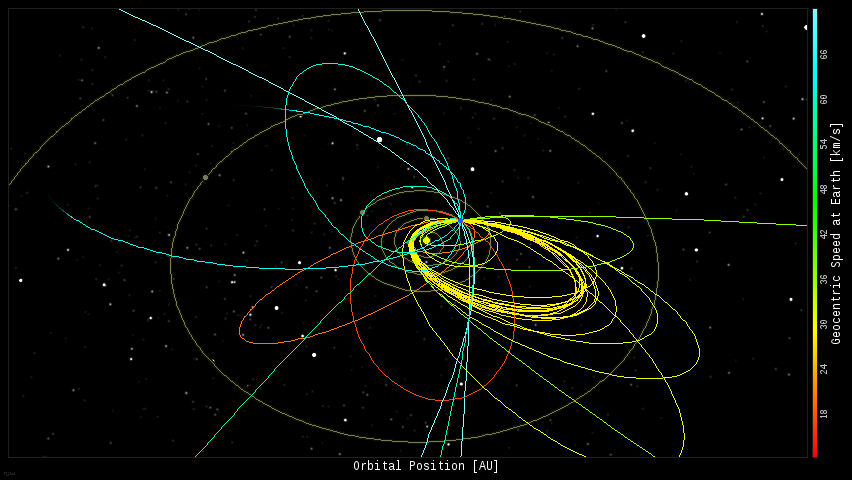
Orbits of Taurids (yellow) detected by NASA meteor cameras on 4 November 2015. Other orbits (red, green, blue) are unrelated to the Taurids.
The Taurid meteor shower is thought to have formed in the last several thousand, perhaps up to 15 thousand years. A large comet entered a very short period orbit in the inner solar system and began crumbling into smaller and smaller pieces. One of these pieces became the well-known comet 2P/Encke, while others crumbled further, forming the Taurid meteoroid stream. The stream is vast and the Taurid meteor showers are only the central part. The night time shower, with distinct north and south branches, begins in August and ends in January. The immense extent of the shower indicates it formed over a long time and is quite massive.
Usually the Taurids produce two distinct peaks. The South Taurids peak in early October, while the North Taurids peak in mid-November – both with about five to seven meteor per hour and occasional fireballs. But in years when fireball showers occur the Taurids behave differently.
The Taurid Resonant Meteoroid Swarm
Studying historical records of Taurid fireball showers (Asher & Clube, 1993; Asher & Izumi, 1998) concluded that there is a localized dense swarm of meteoroids within the Taurid meteor stream responsible for the observed fireball showers. This cloud of large(r) meteoroids is shepherded by Jupiter’s gravitational push and pull. The meteoroids are captured in an orbital resonance with Jupiter: for every 2 orbits by Jupiter, the Taurid swarm meteoroids make 7 orbits – a 7:2 orbital resonance. This orbital dance keeps the Taurid meteoroids in a tight swarm.
Let us try to visualize the swarm. Imagine a circular orbit – a circle. Fix a random point on the circle. This is now the center of the Taurid resonant swarm. The swarm – cloud of meteoroids – extends about 40° along the circle ahead of this point and 40° behind it. The entire swarm covers an arc spanning approximately 80° – nearly 1/4 of the circle. The Taurid stream is in an elliptical orbit, the circle we imagined is squashed somewhat and the swarm stretches and compresses as it goes around the ellipse, but the basic gist remains.
The Taurid resonant swarm is almost like a meteor shower within a meteor shower. Not only is the Taurid resonant swarm a relatively compact cluster of meteoroids, their orbits are very similar. This indicates that the meteoroids separated relatively recently, in a fragmentation of their parent body, perhaps as recently as only a few centuries ago (Spurný et al., 2017; Devillepoix et al., 2021; Egal et al., 2022). The swarm is also denser than other parts of the Taurid meteor shower. Peak activity can reach up to about 15-20 meteors per hour during swarm returns – about a 2-3x increase in activity (Dubetis & Arlt, 2006).
Big Taurid Meteoroids and Fireballs
Not only are there more meteoroids in the resonant swarm, they are bigger! The proportion of fireballs increases from about 1% up to nearly 5% during swarm returns (Dubetis & Arlt, 2006). As Pavel Spurný, an astronomer at the European Fireball network, and his colleagues wrote “impact hazard increases significantly when the Earth encounters the Taurid new branch every few years”. Typical Taurid meteoroids that cause bright fireballs are several centimeters across and have a mass of several tens of grams up to several kilograms.
But some are much larger.
The Taurid resonant swarm and with it the Taurid meteor shower is the only meteor shower with unambiguously confirmed meter-sized meteoroids. A brilliant Taurid superbolide that blazed across the skies over Poland and Germany in the evening of 30 October 2015 was caused by a meter-sized Taurid meteoroid that weighed around 1000 kg (Spurný et al., 2017)! This is not an isolated event. Data from US government satellites that detect meter-sized meteoroid impacts indicates that at least 4 additional very large likely Taurids impacted in 2005 and 2015. The largest of these would have been about 1.5 m in diameter (Devillepoix et al., 2021)!
Brilliant fireball in the skies over Indonesia during the 2015 Taurid resonant swarm return. Not necessarily a Taurid, but highly likely. And a big one at that!
Are there even larger Taurid meteoroids – asteroids – out there in the Taurid swarm?
Potential Killer Asteroids
Detecting asteroids that are essentially inactive cometary fragments is inherently very difficult. Their surfaces are extremely dark, as dark or even darker than charcoal. They reflect very, very little light (2-4%) and only glow feebly, hidden in the starry background.
As sky surveys became increasingly efficient, covering more of the skies and imaging fainter object, large Taurid meteoroids began showing up. During the 2005 Taurid resonant swarm return four large meteoroids were found (Jopek 2011). The largest of these, 2005 UY6 (452639) is a huge rock, measuring 1-3 km in diameter. In 2015 another large Taurid meteoroid was found, a 300-400 m rock designated 2015 TX24 (Spurný et al., 2017). In 2019-2020 further 7 asteroids were found (Egal et al., 2021). Fortunately none of these pose an immediate impact threat.
On the other hand, the broad constraints on the trajectory and origin of the asteroid that hit Tunguska, Siberia on 30 June 1908 are consistent with it potentially being part of the Taurid meteor shower, though not of the resonant swarm (Boslough & Brown, 2018). The impactor was probably a 50-80 m space rock that exploded in the atmosphere at about 5-10 km altitude. It released the equivalent of 10-15 megatons of TNT, about 1000x Hiroshima. The 1908 Tunguska blast happened over a remote part of Siberia. Had it happened over a big city, it would have been as devastating as a powerful thermonuclear bomb. It appears likely that there are many, possibly up to hundreds or perhaps thousands to tens of thousands of Tunguska-sized meteoroids within the Taurid stream and the resonant swarm (Weigert et al., 2025; Boslough et al., 2025). Notably, the timing of the Tunguska blast suggests the meteoroid – *if* it was a Taurid – was not part of the resonant swarm. It potentially indicates the presence of very large meteoroids also outside the resonant swarm.
The Taurid Resonant Meteoroid Swarm returns in 2025
While impact threat is elevated during a Taurid resonant swarm return, it is not something to lose sleep over. But the Taurid fireballs certainly are! We are likely in for a show. Looking at past returns it is quite clear we are in for another fireworks show. In 2025 we encounter the Taurid resonant meteoroid swarm again. We pass through it ahead of its center, the delta(M) is −25°. This is further from the swarm center than in 2005, 2015 and 2022, but closer than 2008 (see table below). Keep in mind that the swarm extends out to at least 40° in delta(M) on either side of its center.
| Year | delta(M) |
| 2005 | 11 |
| 2008 | −30 |
| 2015 | −7 |
| 2022 | 17 |
| 2025 | −25 |
The 2005 and 2015 were the closest to the center of the stream and both produced exceptionally brilliant fireballs and even superbolides (fireballs brighter than −17 magnitude). 2022 and 2008 returns also produced numerous very bright fireballs, but possibly fewer exceptionally big events (Spurný & Borovička, 2023). We may expect the 2025 return to be similar to 2008 and 2022.
Also, the orbital period of the Taurid resonant swarm also means that we encounter it under virtually the same geometry every 61 years. There was a spectacular enhancement in activity and number of bright Taurid fireballs in 1964 (delta(M)=−24°), therefore we can expect another one in 2025. Looks promising – the Halloween fireballs return!
We will see soon!
Check out what observing the Taurid swarm returns in 2005-2022 was like (with photographs) & how best to see and photograph this year’s Taurid swarm return on the links below!