In early September 1859, the skies across much of the world lit up with blood-red and emerald curtains of aurora. People thought cities were ablaze, or that dawn had broken hours early. At the same time, telegraph operators were shocked, paper ignited, and messages were sent without batteries as the geomagnetic superstorm charged up the lines. These are Top 10 interesting facts about the Carrington superstorm.
1. The storm’s intensity was off the charts
The minimum DST index, a measure of ring current intensity and global geomagnetic disturbance intensity, is estimated to have dropped to at least about -850 nT and possibly even down to about -1100 nT (Siscoe et al., 2006; Cliver, 2013; Love, 2021; Love, 2024). Compare that with a minimum DST index of -383 nT for the great 2003 Halloween G5 storms and -406 nT for the intense 10-11 May 2024 Gannon G5 storm.
2. Aurora reached deep into low latitudes near the equator
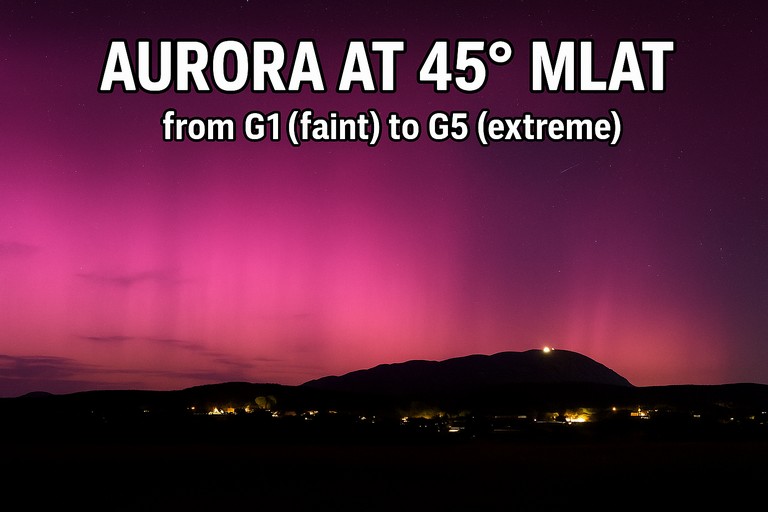
The Carrington geomagnetic superstorm is one of only 20 geomagnetic superstorms in the last 500 years that pushed brilliant aurora deep into low latitudes, below 30° geomagnetic latitude. Bright red aurora was seen overhead in Havana, Cuba. Vivid aurora australis was seen from Santiago, Chile. The lowest geomagnetic latitude aurora was observed during the Carrington superstorm was 17°S MLAT on the vessel Dart in the Pacific. Of the 20 superstorms, only in two was aurora reported even further equatorward, both Carrington-level events.
3. Aurora was so bright it fooled people
Aurora was so bright, many people thought it was dawn. Rocky Mountain News reported that “… the light was so brilliant that one could easily read common print. The men sprang from their bunks, supposing it was daylight, and began preparations for breakfast”.
4. Telegraph systems sparked, shocked, and burned
Telegraph systems were strongly impacted across the world. The New York Times reported “A violent storm of electricity struck the wires. Telegraph paper in the office of the House of Representatives took fire, and the electric fluid shocked the operators severely”. In Philadelphia several telegraphers reported receiving strong shock while trying to operate the telegraph. Sparks flew from the equipment with the smell of burning insulation filling the air. On the other side of the Atlantic in London telegraph messages were garbled and operator were unable to maintain service. Even in the era of wires and Morse code the Carrington superstorm caused a global communications disruption.
6. Compasses went haywire
Compass needles swung wildly during the storm. A magnetogram report from the Royal Greenwich Observatory indicated: “The magnet was suddenly drawn off nearly two degrees, and in less than a minute it returned, after which violent oscillations continued for hours”.

Magnetogram from Greenwich Observatory, London.
7. Telegraph fires
In Baltimore, Maryland it was reported that when operators broke the circuit in the morning of 2 September, “the spark at the instant of breaking the circuit was such as to set on fire the wood-work of the switch-board”. There were other reports of fires set to papers by spark discharges in telegraph receivers.
8. A double superstorm
As exceptional as the Carrington superstorm was, it wasn’t alone. Just four days earlier, on 28–29 August 1859, another superstorm struck! It reached a DST index of –673 nT and produced its own deep low-latitude aurora. Both were triggered by CMEs from the same active region. Two such events within a week is almost unheard of — geomagnetic storms of this size usually occur only once every 50–100 years, having two just four days apart is exceptionally rare.
9. Century or millennium class?
The Carrington geomagnetic superstorm was a century to millenium class event. Recent work by (Gopalswamy, 2017) suggests it was a millenium class event: using the DST index, available for storms since 1957, different regression data fits indicate the Carrington superstorm was an exceptionally rare 1000-year event. This may, however, be due to the relatively short time span of the DST data (only 60 years) and the relative rarity of Carrington-level geomagnetic superstorms. Looking at past events beyond 1957 there is no measured DST data, but there are approximations derived from contemporary geomagnetic and other observations. There are 3 more Carrington level superstorms since the Maunder Minimum (since ~1735): the 17 September 1770, 4 February 1872 and 15 May 1921 events, likely indicating the Carrington event is not that unique (Knipp et al., 2021; Hakayawa et al., 2024). That is 4 Carrington level events in the last 290 years or one every ~70-80 years. In fact, since the end of the Maunder Minimum (~1735), the gap between such storms has never exceeded 89 years… until now. The last was in 1921 — 104 years ago.
10. Modern implications: we’ve been lucky
A Carrington-level geomagnetic storm could cause major damage and produce widespread economic and societal effects. Carrington-level geomagnetic storms drive very large geomagnetically induced currents (GICs) in long high-voltage transmission lines. These GICs can saturate and permanently damage large power transformers. Transformer damage could cause long regional blackouts lasting for months. Satellites, GNSS (GPS), and communications would also be strongly impacted. Radiation and charging can cause satellite anomalies and permanent damage; increased atmospheric drag can reduce satellite lifetimes and cause orbital decay for low-Earth orbit platforms. GNSS positioning and HF (shortwave) radio—used by aviation, shipping, and emergency services—would experience widespread outages during and immediately after the event.

High red aurora and green aurora underneath during a major geomagnetic storm, seen from the International Space Station. Photo: Don Pettit.
Analyses of the effects of a Carrington-level geomagnetic storm explicitly model cascading impacts. That includes transportation breakdowns (airlines, rail), disruption of banking/ATMs and payment systems, water and sewage plants losing power or control systems, and healthcare facilities stressed by prolonged outages. Emergency services would be constrained by communications failures and power loss. Studies estimate very large economic losses. Published scenarios for the U.S. alone estimate losses into the hundreds of billions to ~1–2 trillion USD for initial economic losses and cascading effects, with total societal costs and long recovery raising the figure and impact duration.