Every autumn, as nights grow longer and pumpkins glow on porches, the Taurid meteor shower lights up the sky with slow, dramatic fireballs — nature’s own Halloween fireworks. Unlike the fleeting streaks of the Perseids or Geminids, Taurids are famous for their brightness and brilliance. When one of these slow-moving meteors flares across the heavens, it can briefly rival the Moon in brightness, leaving glowing trails that hang in the sky for minutes.
This year’s Taurid season promises to be worth watching. We’re once again approaching the heart of the Taurid resonant swarm — a cluster of larger meteoroids left behind by comet 2P/Encke that occasionally brings enhanced fireball activity. If past encounters are any guide, the coming weeks could bring spectacular sights. I’ve been lucky enough to witness several Taurid “fireball years” firsthand — in 2005, 2015, and 2022 — and each one delivered moments I’ll never forget.
A Night to Remember: The 2005 Taurid Fireball Swarm
The 2005 Taurid return was widely anticipated in the meteor community. Hints of an approaching swarm came from observers recalling a similar spectacle in 1981. Then, on October 25th, reports began arriving: a brilliant Taurid fireball had lit up the skies over Germany. By early November, it was clear that something extraordinary was unfolding. Reports of bright fireballs over Poland were coming in every night, culminating in a brilliant -15 magnitude Taurid on November 4th.
The skies finally cleared on November 8th. I set up to observe with Javor Kac of Skies of Slovenia, expecting perhaps a few late stragglers. Instead, we were treated to two unforgettable hours — four Taurid fireballs, each one brighter than Venus.
That night was also a crash course in meteor photography. Being new to DSLRs, I had enabled long-exposure noise reduction — a mistake I realized too late. When a magnificent –10 magnitude Taurid streaked straight across my camera’s field of view, my borrowed Nikon D70 was busy making a dark frame. In Javor’s immortal words: “…there goes your meteor photo of the decade.”
Lesson learned: never use long-exposure noise reduction during meteor photography. Another brilliant –8 magnitude Taurid slipped through a narrow gap between the horizon and Javor’s camera frame — another reminder to always include the horizon when shooting meteors.
We observed again the next night and saw another –5 magnitude fireball. My last Taurid of that year came on November 18th — a –3 magnitude meteor bright enough to punch through the full moonlight.
Missed Chances and Glimpses: 2008
The 2008 swarm was less cooperative. Autumn weather lived up to its reputation — cloudy, damp, and frustrating. I managed only one night of observing, but even then a Taurid fireball graced the sky. Sometimes all it takes is one to make the effort worthwhile.
The 2015 Taurid Extravaganza
A decade later, in 2015, the skies over Slovenia — and much of southern Europe — were exceptionally clear for weeks. From late October into mid-November, I spent more than 40 hours in 11 nights under clear skies, witnessing and photographing 52 Taurid fireballs.
The first signs appeared on October 30th, when a –10 magnitude Taurid lit up the southern horizon, followed by another equally bright meteor the next night. Even with a full Moon flooding the sky, bright fireballs were frequent — I saw five in just four hours.
Then came the unforgettable one — a –15 magnitude Taurid bolide. I caught it out of the corner of my eye before it exploded into brilliance, lighting the sky electric blue, brighter than the full Moon. Its persistent train glowed bright and vivid green for several seconds, bright enough to cast shadows. The glowing trail twisted and drifted for over half an hour even in the light of the Quarter Moon, and was still visible in photos more than two hours later. It was the kind of sight that sears itself into memory.
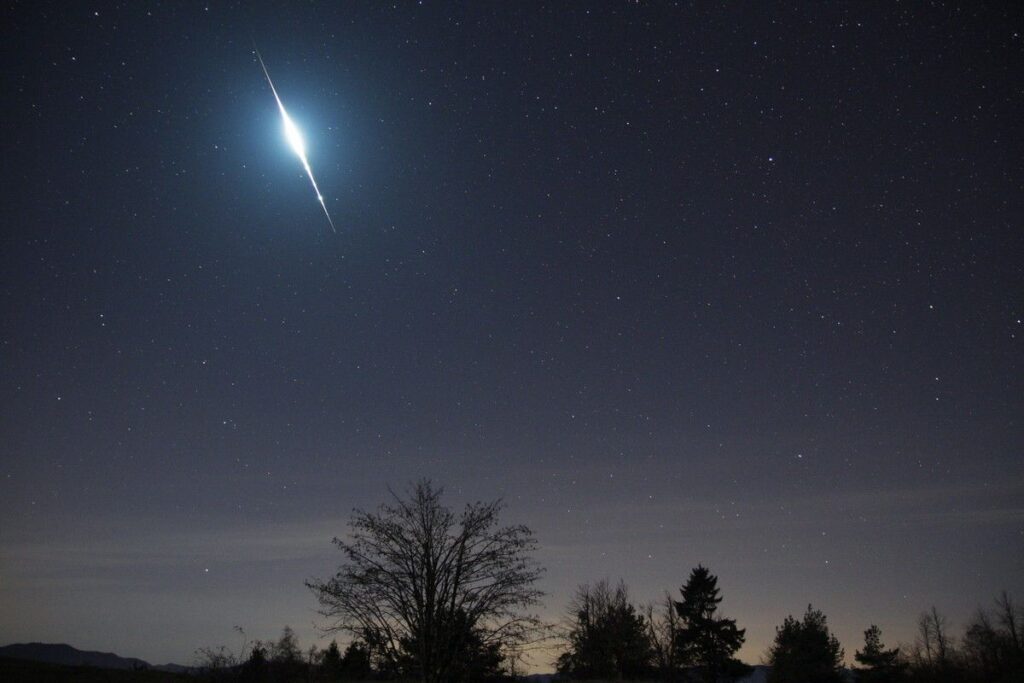
Brilliant -15 magnitude Taurid fireball on 3 November 2015. The Square of Pegasus is on the right. 17 mm f/2.8 lens, 15 seconds at ISO 1600. Photo: Jure Atanackov.
There were more bright Taurid fireballs, including two -10s. I saw one of those through my windshield while driving back home.
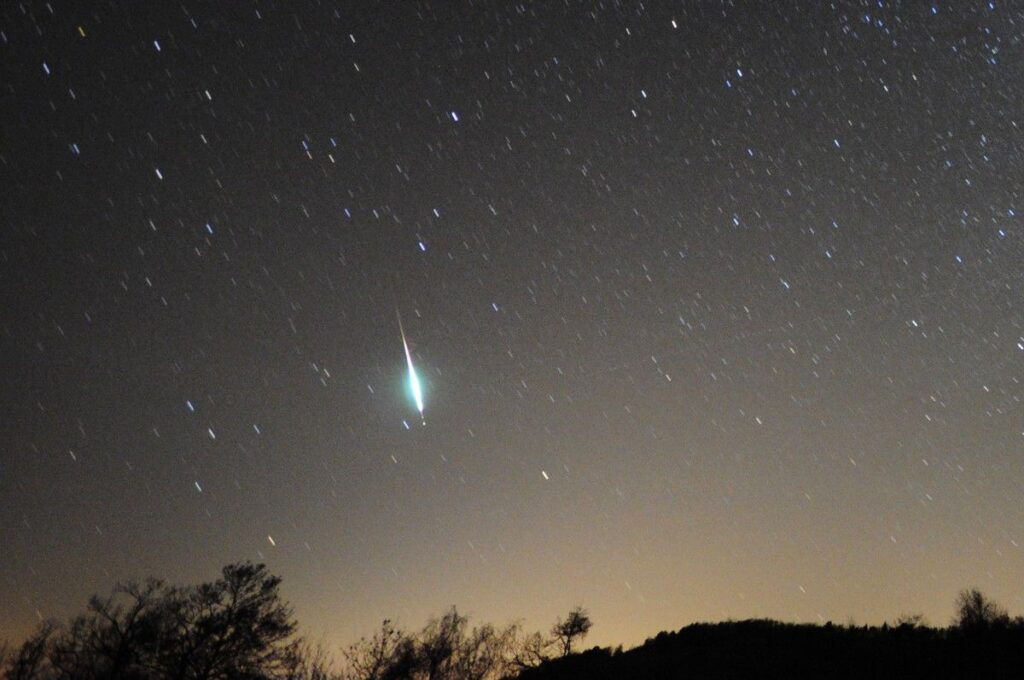
-10 magnitude Taurid fireball on 12 November 2015. 10 mm f/4 lens, 100 seconds at ISO 2000. The fireball lit up the sky and the ground. Photo: Jure Atanackov.
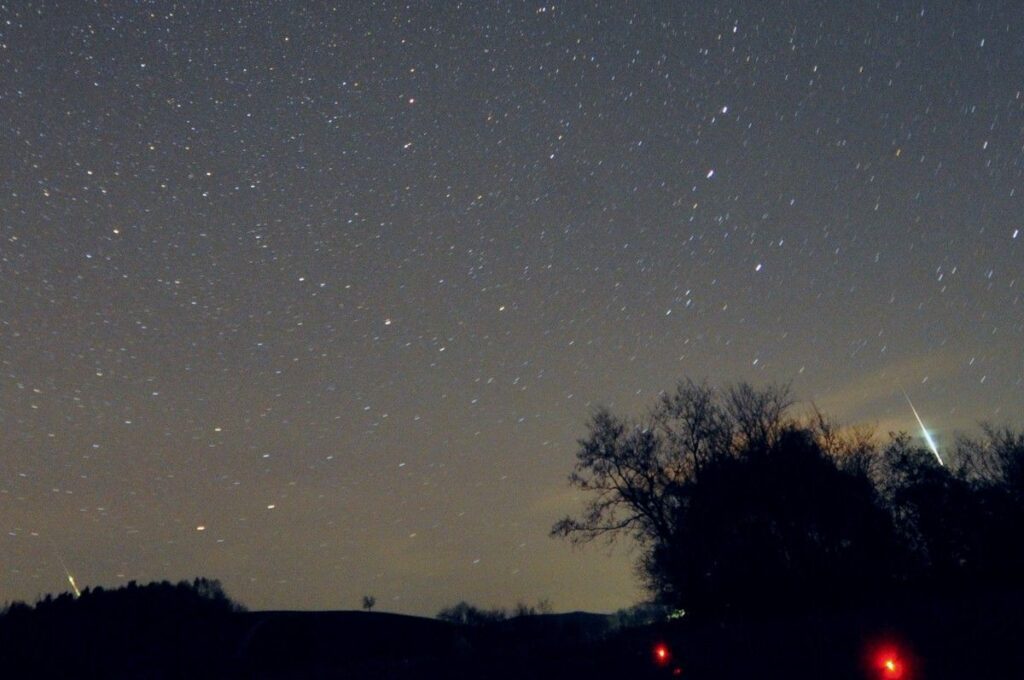
Two Taurid fireballs in less than two minutes: a -4 and a -7 magnitude meteors. 7 November 2015. 10 mm f/4 lens, 120 seconds at ISO 2000. Photo: Jure Atanackov.
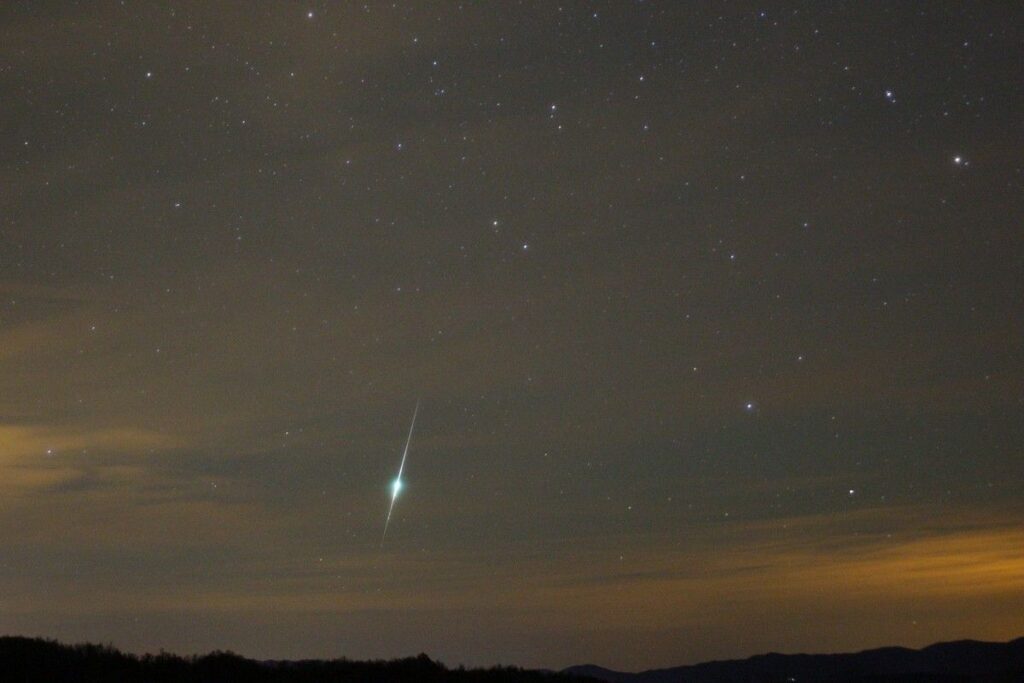
-6 magnitude Taurid fireball low over the eastern horizon. 8 November 2015. The fireball produced a bright flash that briefly illuminated the scene. 28 mm f/4.5 lens, 20 seconds at ISO 4000. Photo: Jure Atanackov.
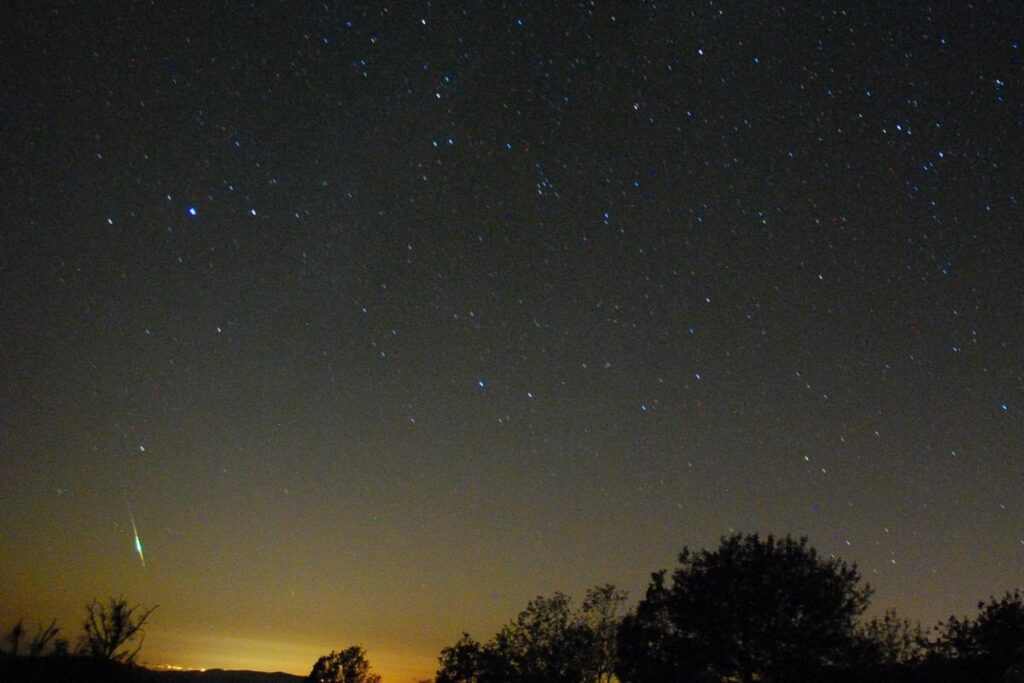
-8 magnitude Taurid fireball very low (a few degrees) over the western horizon in light pollution from Italy. 2 November 2015. Distant, and a brilliant meteor for anyone directly underneath it. 18 mm f/3.5 lens, 35 seconds at ISO 1600.
2015 Taurid spectacle across the world
And the 2015 return dazzled observers around the world. The European Fireball Network – a network of all-sky cameras in central Europe monitoring the skies for fireballs – recorded over 200 fireballs in just three weeks (Spurny et al., 2017). On October 31st, a –19 magnitude Taurid superbolide lit up the skies over Germany and neighboring countries — caused by a meter-sized meteoroid. Just three hours later, another –15 magnitude event was recorded. This is exceptional. An observer may be lucky to see one or two -15 magnitude fireballs in their lifetime. You’d be extremely lucky to see a -19 magnitude fireball. To see both in a span of only a few hours is a cosmic jackpot. Yet this is possible during a Taurid resonant swarm return.
Cameras around the world, like the one at the Gemini North telescope on Mauna Kea, captured brilliant Taurid fireballs during this period.
A brilliant likely Taurid also lit up the sky over Thailand.
Another Brilliant Return: 2022
After a few quieter years, 2022 brought another favorable encounter. Clear weather coincided with dark skies in late October and the first weeks of November were moonlit. Bright Taurid fireballs were again reported worldwide. From my observing sites, numerous fireballs up to –10 magnitude were seen over 9 nights, though the brightest one evaded my cameras.
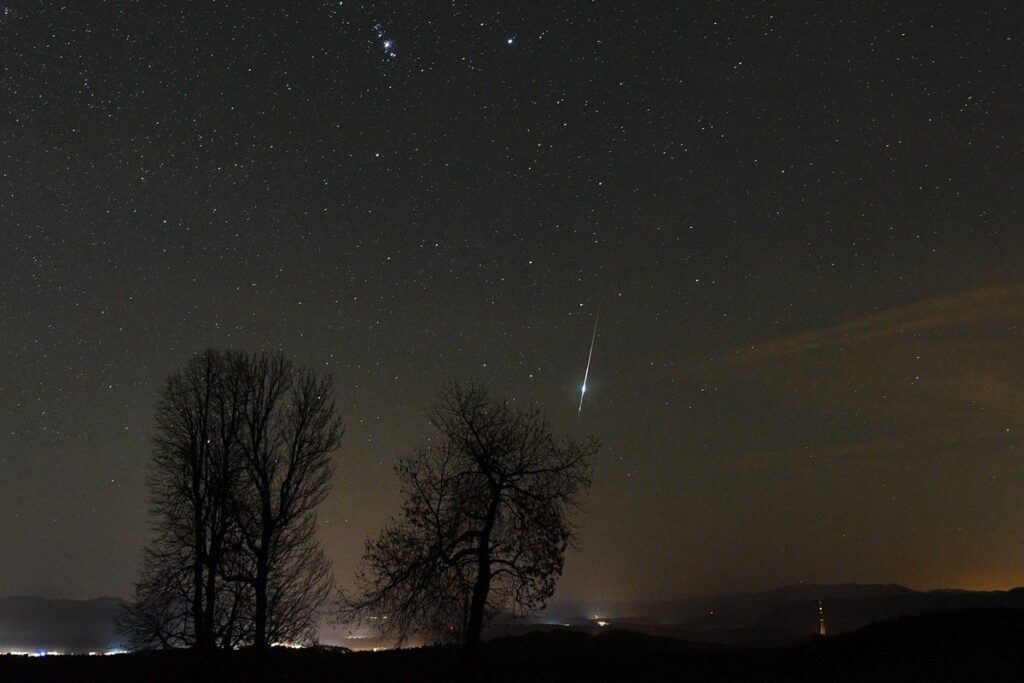
-5 magnitude Taurid low in the south under Orion on 30 October 2022. 16 mm f/2.8 lens, 15 seconds at ISO 3200. Photo: Jure Atanackov.
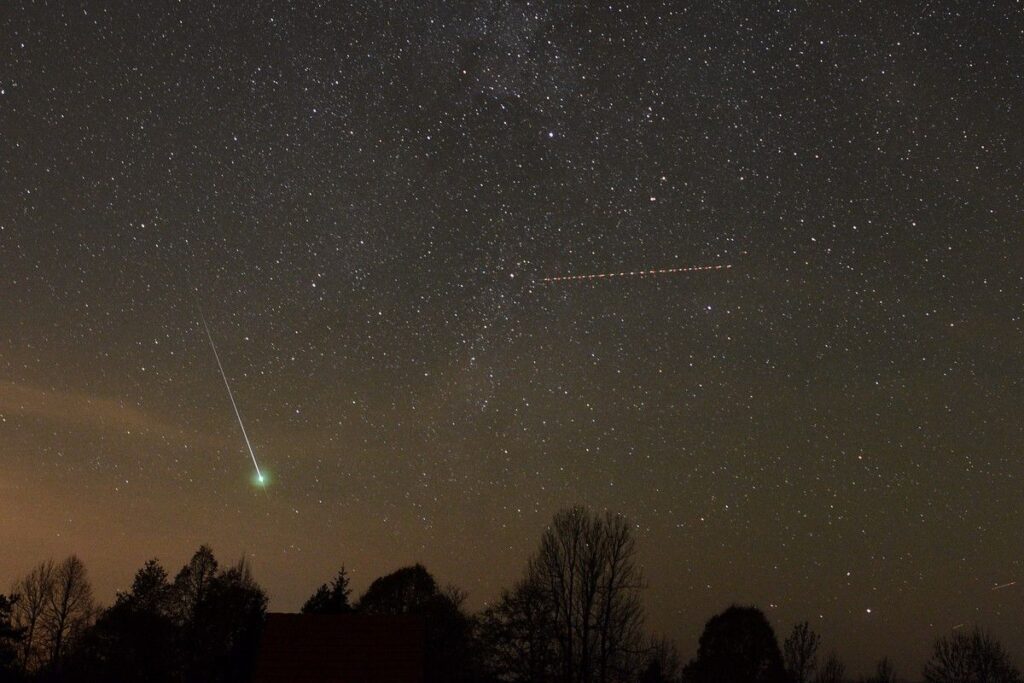
-6 magnitude Taurid on 30 October 2022. 20 mm f/2 lens, 20 seconds at ISO 1600. Photo: Jure Atanackov.
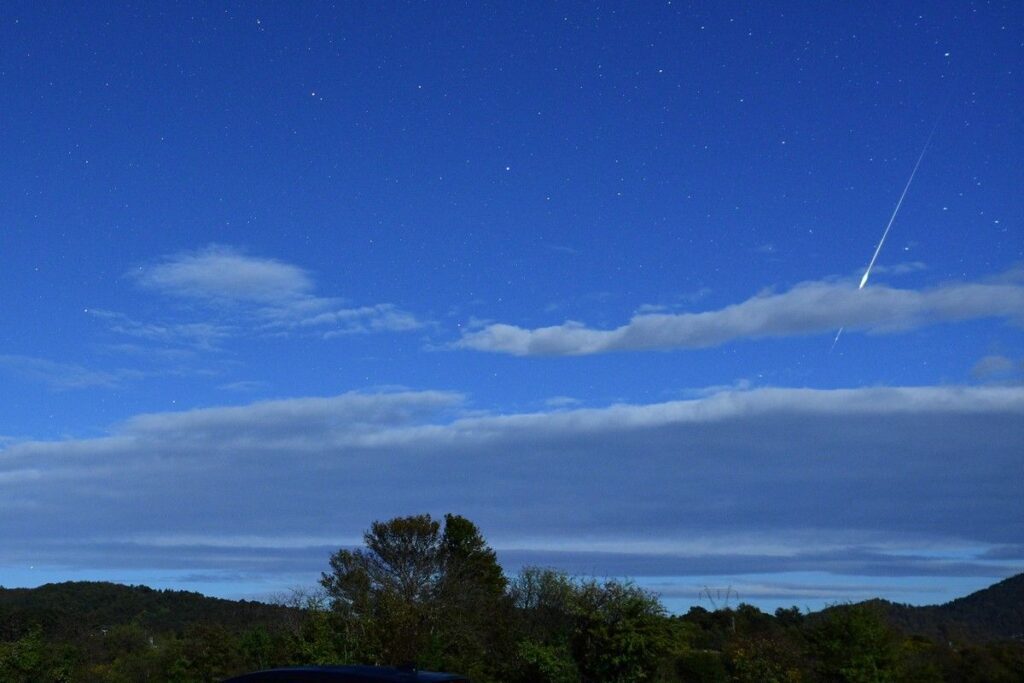
-6 magnitude Taurid in bright moonlight on 6 November 2022. 20 mm f/2 lens, 8 seconds at ISO 800. Photo: Jure Atanackov.
Looking Ahead: The 2025 Taurid Swarm
In previous encounters, the geometry of Earth’s path through the swarm’s orbit made all the difference. The great fireball years — 2005 and 2015 — occurred when our planet passed very close to the swarm’s center. The 2008 and 2022 encounters, a little farther off, still produced enhanced activity and occasional spectacular meteors.
This year, 2025, Earth will again pass through the swarm, slightly ahead of its center. A bit further than in 2022, but closer than in 2008. This is a geometry that historically favors an uptick in bright Taurids. If conditions follow the pattern, we may see a noticeable increase in bright fireballs from October 25th through mid-November.
The First Quarter Moon on October 29th will cause some interference in early November, but bright Taurids easily punch through moonlight. Full Moon falls on November 5th, with dark skies returning after November 12th.
In short: this is a year to keep your eyes on the sky every clear night in late October and early to mid November.
See you under the stars!