Want to see the 2025 Geminid meteor shower? Here are my top 10 tips to best see it (after 25+ years of observing):
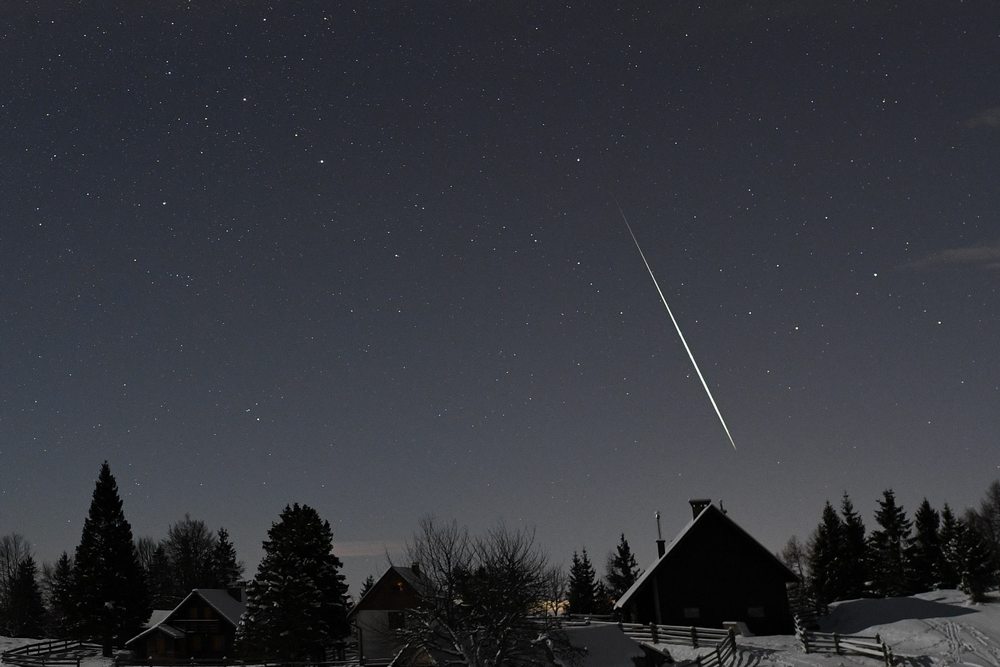
Bright Geminid meteor just above the southern horizon. Krvavec, Slovenia. December 14th, 2022. Photo: Jure Atanackov.
- Be out on in the night December 13-14th. The peak is expected early on December 14th. More exactly the peak time is 8h UT on December 14th. That is 8h am GMT, 3h am EST and 12h am PST (midnight between Dec 13/14). This is the night December 13/14th (Saturday/Sunday). Perfect timing.
- The exact time does not matter. Don’t worry if it is daytime at the exact time of predicted peak at your location. The Geminid peak is not very sharp, be out on the peak night and you will certainly see near-peak rates.
- Don’t skip the night before. The Geminids are very good even the night before the peak. The rates are about half that of the peak night, but for the Geminids this translates into a very good show! If your weather forecast is uncertain, this is an important ‘insurance night’.
- Give your eyes time to adapt. It takes about 20-30 minutes for the eyes to adapt to darkness. Avoid phone screens; if needed, use deep-red mode at minimal brightness.
- Don’t stare at the radiant. Geminids do radiate from Gemini, but meteors are short there. Look elsewhere in the sky and about 30-45° above the horizon. Many meteors will appear fairly low over the horizon, especially if you are observing from a location high in the mountains.
- Dress far warmer than you think you need to. Geminid nights are cold. You will be outside for some time, mostly not moving much. Use multiple layers, thick socks, insulated boots, and a windproof outer layer. A sleeping bag on a reclining chair is ideal.
- Use a reclining chair or lie flat. The wider your sky view, the more meteors you catch. A foldable recliner or a simple camping mat makes a huge difference. Add a layer of cardboard or a foam sleeping pad under your chair/mat. Cold ground is a heat sink and will chill you faster than the air.
- Don’t use binoculars or a telescope. Only observe with your naked eyes. Meteors are swift and long, binoculars and telescopes have far too small fields of view to observe them effectively. It is like observing through a drinking straw.
- Plan a long observing window. The Geminids are visible all night long. Unlike all other major meteor showers you can actually see decent numbers of Geminids in the evening hours. The best time to observe the Geminids from mid evening (~20h local time) to early morning (~5h local time). Evening rates improve rapidly as Gemini rises. If possible, also observe the night before the peak, at the same times. You should see some good meteor rates.
- Don’t chase the numbers. The peak ZHR (Zenithal Hourly Rate) is 150 meteors per hour. That assumes a dark sky and the Geminid radiant overhead. But the numbers can vary. They depend on your eyesight, on your visual acuity, sensitivity to motion, etc. Some people see more, some less. Don’t worry about it, just enjoy the show. And it is a show!
Bonus tip: The Moon wil not be a major problem. The Moon will be in a faint Waning Crescent phase (about 30% illuminated) and will rise around 2:00 AM local time. Don’t worry about it, the Geminids will shrug off the moderate moonlight.
Clear skies, good luck and I will see you under the stars!