It has been a roller coaster ride of anti-establishment ranting, textbook selection bias and straight up grifters giving society cognitive cancer. It is a shame, as a visit by an alien comet is in itself an extraordinary event. A visitor from another solar system, a time capsule carrying with it messages of other worlds and distant past. It is a time capsule with. To be updated / expanded as more BS about comet ATLAS is posted online.
Comet 3I/ATLAS behaves differently from other comets, therefore it is aliens
No. First – even our own comets, that is comets that originate in our Solar System, are wildly diverse. Some are rich in dust and form spectacular dust tails. Others are rich in gas, but poor in dust. Some are exceptionally active, others are almost or completely dormant. Some begin outgassing at large distances from the Sun, others begin much closer. Some are active intermittently, occasionally producing big outbursts of dust and gas. Some emit very fine dust, some crumble in large pebbles and boulders. Some fragment into multiple smaller fragments, some fall apart altogether. Some are tiny, others large, some are gigantic. And some appear to be fragments of larger icy bodies, like Pluto.
Some Solar System models suggest a significant fraction of comets in the Oort clouds were possibly captured during close approaches of other stars from their Oort clouds. We may be seeing ‘alien comets’ fairly regularly, with no way of knowing whether they are originally from our Solar System or were captured later.
But the chemical composition! It is somewhat different from other known comets, but we only know our comets and two other interstellar ones. We do not know all the flavours of comets from other stars, we have barely started to taste them.
But the orbit! True, it is highly improbable, but it also inherently suffers from small sample observational bias. We may want to revisit the case when we have a large sample of interstellar comet orbits/trajectories. This has happened before, for example the skewed distribution of orbits of some trans-Neptunian objects indicated the potential presence of a large perturbator in the outer solar system – planet Nine. As more trans-Neptunian objects are found it appears that the initial skewed distribution may have been caused by observational bias.
There are 17 (more?) comets in coordinated (?!) approach to the Sun together with 3I/ATLAS right now!
No. There are videos circulating about how there is supposedly a ‘coordinated’ pulse of comets in the solar system, with up to 16 comets ‘associated’ with 3I/ATLAS.
I can’t believe I’m doing this, but … let’s break this down. Here is the list of the supposedly ‘coordinated comets’ with perihelion dates and distances (other posts and videos may include others; table shamelessly compiled with ChatGPT):

5 of these are returning periodic comets, these return every few years to a few decades. There are about 500 known periodic comets and many more waiting to be discovered. At any given time there will be a number of these present. So count these out.
That leaves 11 long period comets. Are 11 long period comets near the Sun unusual? No. There is no clustering of orbital elements, they are unrelated, coming from random directions in the sky – that’s how Jan Oort figured out the Oort cloud! There are about 40 to 60 long period comets reaching perihelion each year. Being random there are more at some times and less at other. Seeing 11 of them is not exceptional, it is average.
Those names? LONEOS, NEAT, PanSTARRS, ATLAS? That’s names of sky survey programmes. They are very effective at detecting incoming comets as the scan large parts of the sky every night. That is why we know of so many comets. Expect the number of discovered comets to further increase, possibly enormously, as the Vera Rubin Observatory comes online. We will likely know of many tens of inbound and outbound long period comets at any given time.
NASA is hiding images of comet ATLAS!
No. In addition to the ongoing government shutdown it is typical that scientists do at least a thorough preliminary analysis of obtained observational data before announcing first results. A delay between observations and announcements/publications is not hiding data, it is scientists doing science.
Also, the expectations are likely (way) too high. The largest telescope in orbit around Mars is the 0.5-m HiRISE camera on Mars Reconnaissance Orbiter. The resolution at the comet’s distance (18 million kilometers, nearly 47x the Earth-Moon distance) is on the order of 15-30 km per pixel. Unless the comet – or object if you will – is much larger than currently estimated, it will not be resolved even by that camera. It would need to be exceptionally large, 100+ km for the camera to begin resolving detail.
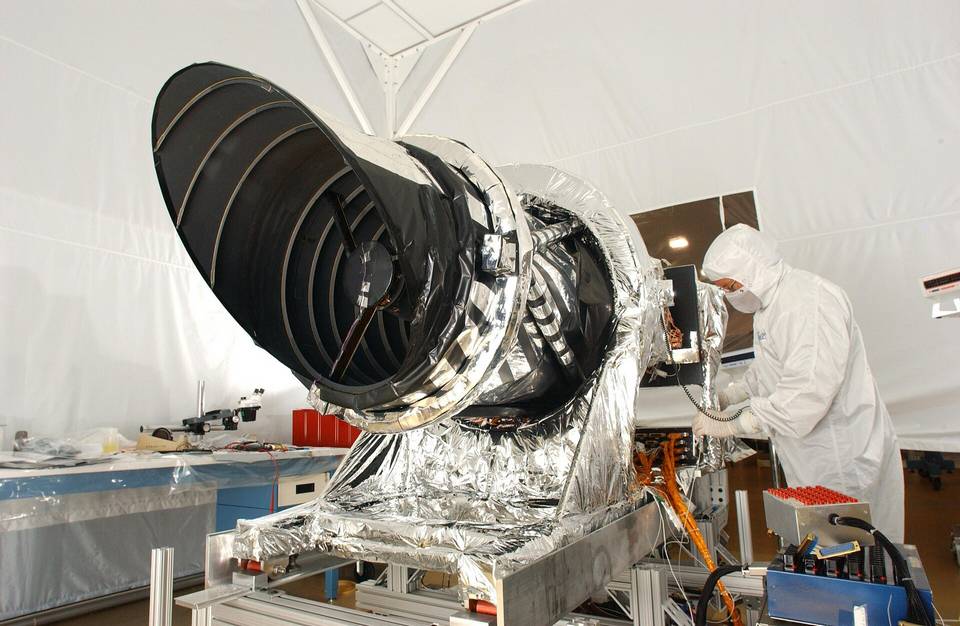
MRO HiRISE (High Resolution Imaging Science Experiment) camera in preparation in 2005. Even this 0.5-m telescope is not large enough to resolve the nucleus of comet 3I/ATLAS.
Comet ATLAS blazing in and across the Martian sky?
No. The Mars approach was close, but not that close. Comet ATLAS did not blaze in the Martian skies. Not even close. In fact, comet Lemmon is currently (far!) brighter in our skies than comet ATLAS was at closest approach in Martian skies. It is actually an easy calculation: the comet was a faint 12th to 13th magnitude as seen from the Earth. You would need a decently big amateur telescope to see it (10″ or larger). Taking into account the comet’s distance from the Earth and from Mars, we can work out that in the Martian skies comet ATLAS would have glowed feebly at about 8th magnitude, just in range of large binoculars or better, small telescopes. It would not have been visible with the naked eye, let alone be a bright object in the sky.

Comet ATLAS blazing in Martian skies? Cylindrical alien mothership? No. Just Mars’ moon Phobos racing across the sky. Photo: NASA/JPL-Caltech.
The streak in the Martian sky captured by NASA Perseverance rover’s mastcam was not comet ATLAS, let alone an elongated cylindrical artificial object, it was Mars’ moon Phobos. If you could see it from the surface of Mars, Phobos would be a bright, fast-moving, small disc, rising in the west, setting in the east, changing phase rapidly as it orbits every 7 h 39 m. It would be as bright as the crescent Moon, enough to cast very faint shadows. You’d see it move perceptibly over the course of minutes, and even cast visible shadows when near full phase.
Comets break up in the intense heat at 203 million km from the Sun
No. There is no ‘intense heat’ at 203 million km from the Sun. We all should know this, being ~150 million km from the Sun right now. But comets do fragment, that is not something unusual. They are very fragile. A comet (nucleus) is essentially an icy dirtball, a loose and porous mesh of crystal grains with ices between the crystal grains. It may look like rock, but it really isn’t. The average density of intact cometary nuclei – from measurements of comets that were visited by probes (67P/Churyumov-Gerasimenko, 9P/Tempel 1, 81P/Wild 2, 103P/Hartley 2, 19P/Borrelly and 1P/Halley) – is around 300-600 km/m3. The density of cometary nuclei is closer to that of packed snow than to that of rock! The Rosetta mission showed the stuff comet 67P/Churyumov-Gerasienko’s nucleus is made of is a ‘dusty snowbank’ or ‘very fluffy ice-dust mixture’, with 70-80% porosity. Mechanically weak, but cohesive enough to hold together.
So comet nuclei are fragile. As they near the Sun they begin to slowly warm up, and if they make a close approach to the Sun, heat up. As the Sun heats the nucleus up, ices begin to sublimate – that is turn directly from ice to gas. As they do, they blow off of the comet’s surface in big jets. The sublimating gas also releases the dust grains embedded within it and the nucleus slowly erodes. It is estimated that the nucleus of comet 1P/Halley is stripped of its top several meters every time the comet rounds the Sun.
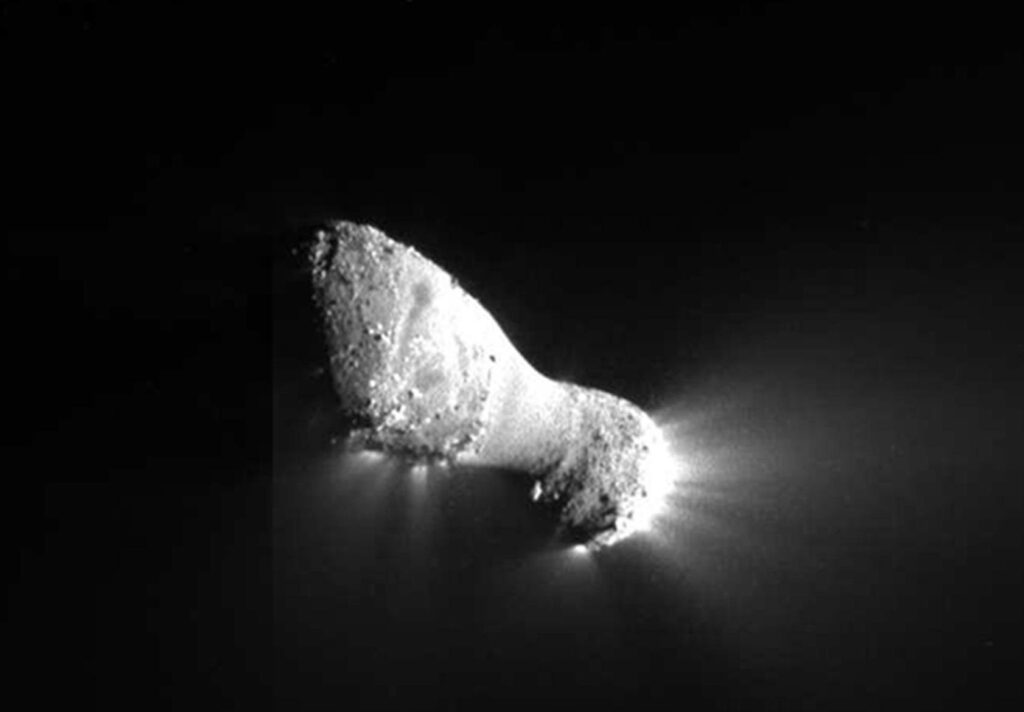
Image of the nucleus of comet 103P/Hartley 2 taken by NASA’s EPOXI mission. Note the jets of gas and dust.
As the comet’s nucleus heats up, more and more material is eroded. Pockets of subsurface gas may accumulate and release in big outbursts. Thermal stresses build up. Erosion may be uneven, depending on the composition, heterogeneity and irregularity of the nucleus. Rotation may be too rapid for the comet to hold together. Many mechanisms can result in a comet fragmenting.

Nucleus of comet 67P/Churyumov-Gerasimenko imaged by the Rosetta probe. True color image.
Take the nucleus of 67P/Churyumov-Gerasimenko for example – it is essentially two big chunks of comet nucleus connected by a thin neck. If the neck erodes sufficiently, the two chunks may separate and form two fragments.
We know of many comets that have fragmented. Some came very close to the Sun, like the Great September comet of 1882 and other Kreutz sungrazers. Some fragmented further away, like 73P/Schwassmann-Wachmann 3, 141P/Machholz 2 and many others. Some, like C/1999 S4 (LINEAR) completely disintegrated into dust and boulders. And there is evidence that cometary nuclei fragment even very far from the Sun.
Final word (?)
As exciting as it is to see a comet from another solar system, an alien comet if you will, it would be far more interesting to see an artificial alien object. The possibility of artificial object should not be discarded a priori, that would indeed be bad science. It would, however, be just as bad science if an exceptionally low probability scenario – both theoretically and observationally – would be blown out of proportion. In this respect I very much appreciate dr. David Kipping‘s work and highly recommend his podcast and Youtube channel – Cool Worlds.