Early on August 21st, 2025 an active region on the far side of the Sun launched a very fast full-halo CME. This was one of the fastest CMEs of Solar Cycle 25 so far. An Earth-directed CME of such magnitude is capable of producing a severe (G4) to extreme (G5) geomagnetic storm. Here is what happened and how this even compares to other big ones.

The far-side full-halo CME on August 21st, 2025 in LASCO C2 images. The image show the expanding CME in 15-minute intervals, starting at 8:24 UTC. By the fourth image the edge of the CME had already reached the edge of the field of view. Image: SOHO.
This far side full-halo CME is indeed very fast, clearing the field of view of LASCO C2 coronagraph in about 45 minutes.
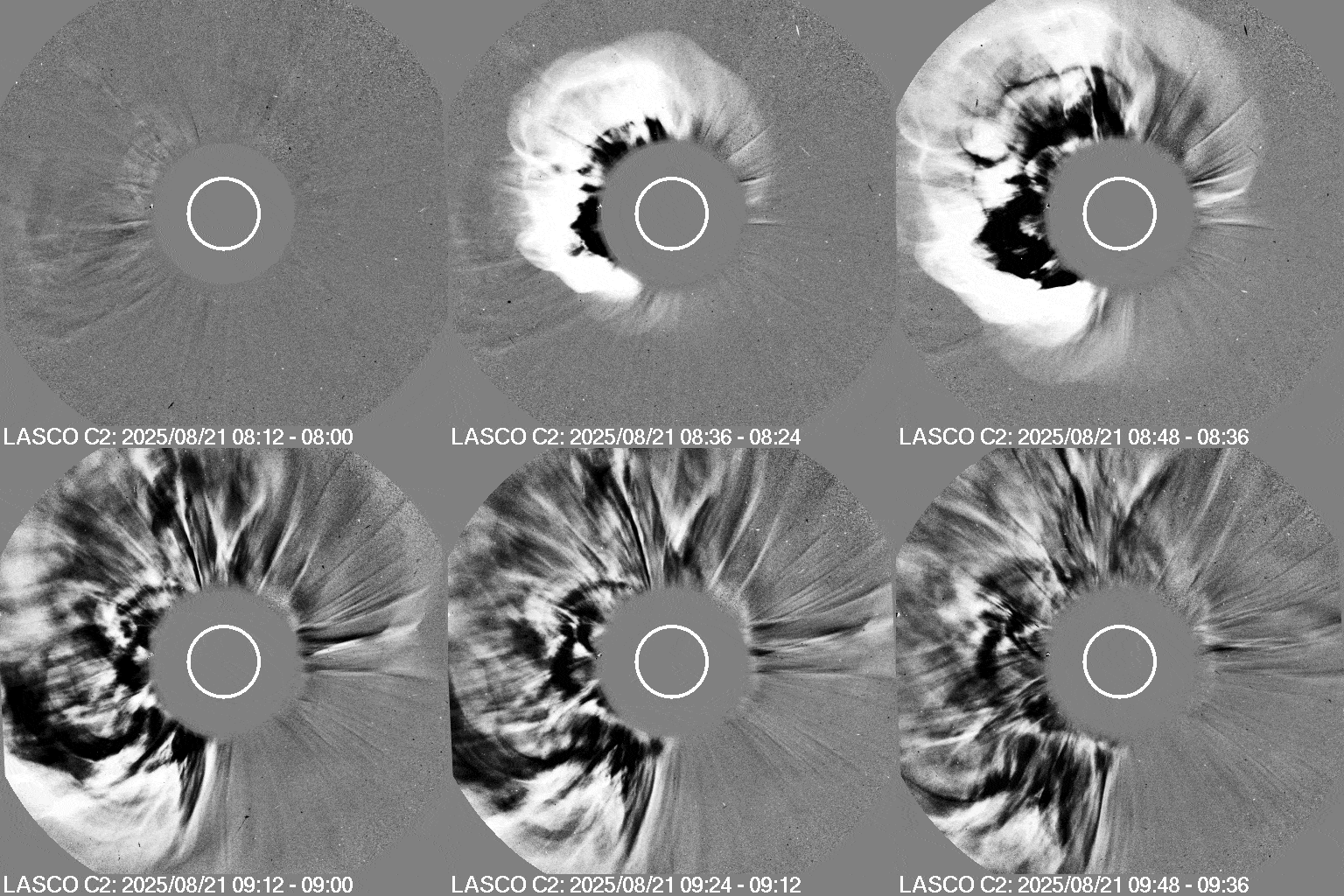
The August 21st, 2025 far-side full-halo CME in LASCO C2 imagery (running difference).
The geometry of a CME, that is how symmetric or lopsided it is tells us something about the location of its source: the more symmetric, the closer the source is to the center of the solar disk, while a more lopsided CME indicates a source closer to the edge of the solar disk. This CME appears slightly lopsided to the NE, possibly suggesting a source in the northern hemisphere somewhat past the central meridian.
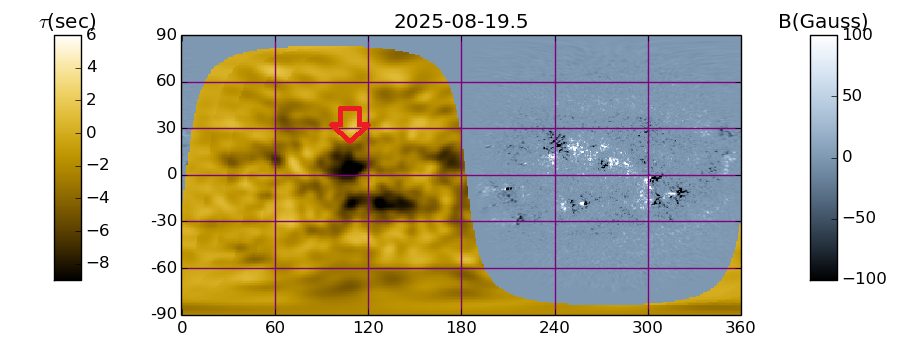
Far side of the Sun imaged with helioseismology. The most likely source active region for the CME is marked by the red arrow. Image: NASA/SDO.
The latest far side image by SDO using helioseismology indicates two large active regions just past the CME, one in the northern and one in the southern hemisphere. The active region in the northern hemisphere appears to be the most likely source. The region will rotate over the eastern solar limb into view on August 25th.
How does this very fast CME compare to other similar events?
December 17th, 2024 exceptionally fast far-side full-halo CME
This exceptionally fast CME was clocked at approximately 3161 km/s. This is an exceptional, extremely rare event and one of the fastest CMEs not only of Solar Cycle 25 so far, but ever observed.

December 17th, 2024 exceptionally fast far-side full-halo CME in LASCO C2 imagery (running difference).
March 13th, 2023 exceptionally fast far-side full-halo CME
Another exceptionally fast CME was clocked at 3000+ km/s. The CME reached the edge of the LASCO C2 field of view in about 30 minutes, even faster than the CME today!

December 13th, 2023 exceptionally fast far-side full-halo CME in LASCO C2 imagery (running difference).
The closest we have come to being impact by CMEs of this magnitude in the last 3 cycles is during the 2003 Halloween storms. Two very fast full-halo CMEs in quick succession with speeds between 2000 and 2500 km/s. They caused two successive G5 storms. The two fastest CMEs of Solar Cycle 25 were significantly faster, as was the Carrington-level CME on July 23rd, 2012.
| Event | speed | Earth impact | Effects |
| August 21st, 2025 far-side full-halo CME | 1657 km/s | none | none |
| December 17th, 2024 far-side full-halo CME | 3161 km/s | none | none |
| March 13th, 2023 far-side full-halo CME | 3000+ km/s | none | none |
| July 23rd, 2012 far-side full-halo CME | 2500-3000 km/s | none | none (“modern Carrington-class near miss”) |
| November 4th, 2003 limb CME (X45-X65 flare) | 2300-2400 km/s | glancing | G2 storm |
| October 29th, 2003 full-halo CME (X24.6+ flare) | 2450 km/s | direct | G5 storm (DSTmin = -383 nT) |
| October 28th, 2003 full-halo CME (X13.3 flare) | 2000 km/s | direct | G5 geomagnetic storm (DSTmin = -353 nT) |
| July 14th, 2000 full halo CME (X8.2) | 1670 km/s | direct | G5 geomagnetic storm (DSTmin = -301 nT) |
We have been successfully dodging extremely fast CMEs throughout the last two solar cycles. The July 23rd, 2012 far side event would have resulted in a modern Carrington level geomagnetic storm, unlike anything we have seen in over 100 years and possibly more. We know that by the fortune of having a probe just in the right place at the right time (Stereo A) to measure the impact of the CME. We do not know just how strong a punch the two super fast CMEs in 2023 and 2024 packed, but any CME going so fast is more than capable of generating a G5 storm and possibly a Carrington-level event if the IMF is favourable. And today we may have dodged another one. When will our luck run out?