About twenty years ago our skies were frequently adorned by colorful aurora displays far into the mid and even low geographic latitudes. People were seeing aurora far south of the typical polar and subpolar regions where auroras typically reside. Then the auroras dried up. And did not return. For nearly twenty years.

Gone from the skies for two decades. Photo: Jure Atanackov.
Low latitude auroras
Low latitude auroras, that is auroras seen far equatorward of the typical polar and subpolar latitudes, are rare. Recently they have become synonymous with observations from the Mediterranean in Europe and Texas and particularly Florida in the USA. Florida aurora seems to be an unofficial benchmark event now.
I started observing aurora from my location in Slovenia back in 2000, just as Solar Cycle 23 was ramping up to its first peak. Slovenia is far south from the northern latitudes typically associated with aurora – no permafrost, elk or puffins here. In fact, auroras in Slovenia are about as likely as in southern France, northern Spain, Florida, Texas, south California, and northernmost Japan.
Geomagnetic vs. geographic latitude: why North America wins?
This global distribution may be confusing. Florida sits much further south geographically (~28°N) than Slovenia (46°N) – so why do both locations experience low-latitude auroras about equally as often? Furthermore, since Slovenia sits at a geographic latitude similar to southern Canada, shouldn’t it also see about as much aurora?
Not quite. North America is *far* more likely to see auroral displays than Europe at the same geographic latitude. The key lies in the difference between geographic and geomagnetic latitude.
The geographic latitude is the angular distance from the equator to the geographic pole. While the geographic pole is determined by the Earth’s rotational axis, the geomagnetic pole is determined by the dipole axis of the Earth’s magnetic field. The magnetic dipole axis and the rotational axis do not coincide: the magnetic dipole axis is tilted at 11° to the rotational axis.
This means the geographic and geomagnetic poles are in different locations. While the north geographic pole is located in the Arctic ocean, the north geomagnetic pole is located in the Canadian Arctic, shifted towards North America. Consequently, locations in North America sit at significantly higher geomagnetic latitudes than locations at the same geographic latitude in Europe
Rare low latitude auroras
Low latitude auroras only occur during very strong geomagnetic storms. There is no single measure of the strength of a geomagnetic storm that is directly indicative of how far into low latitudes aurora is visible. But in my experience the DST index is a fairly decent indicator. The Dst index measures the Earth’s ring current strength indirectly in nanoTeslas (nT) – the deeper into negative numbers it drops, the stronger the storm. When the DST index hits -200 nT there is usually already a bright and obvious aurora in the northern sky from Slovenia.
Here are a couple of examples:
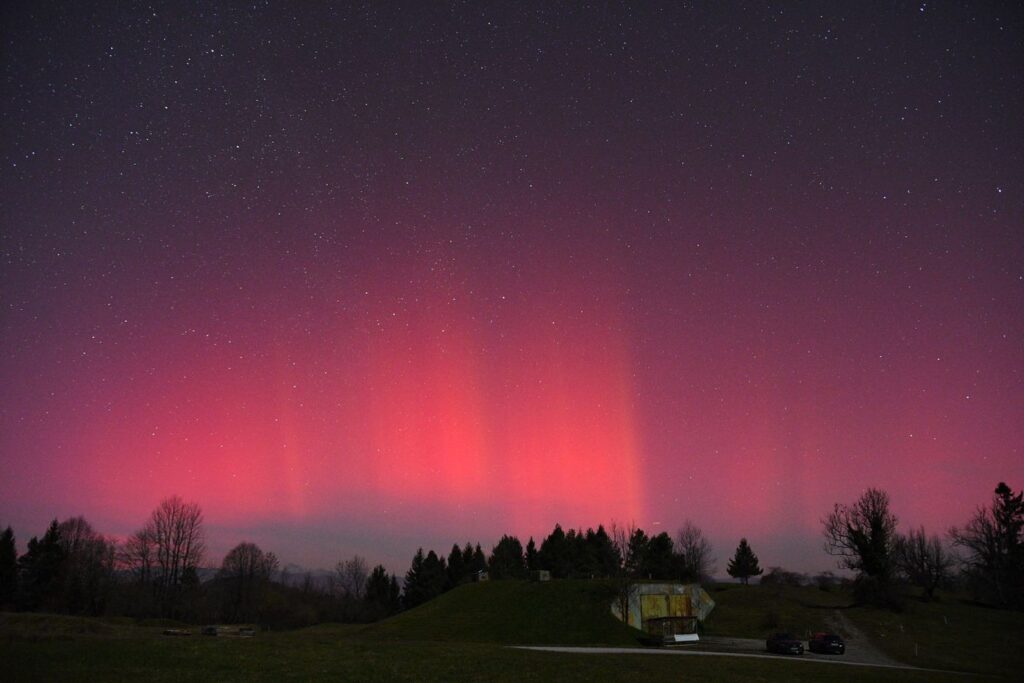
November 11-12, 2025 aurora at DST = -217 nT. Medvedje Brdo, Slovenia. Photo: Jure Atanackov.
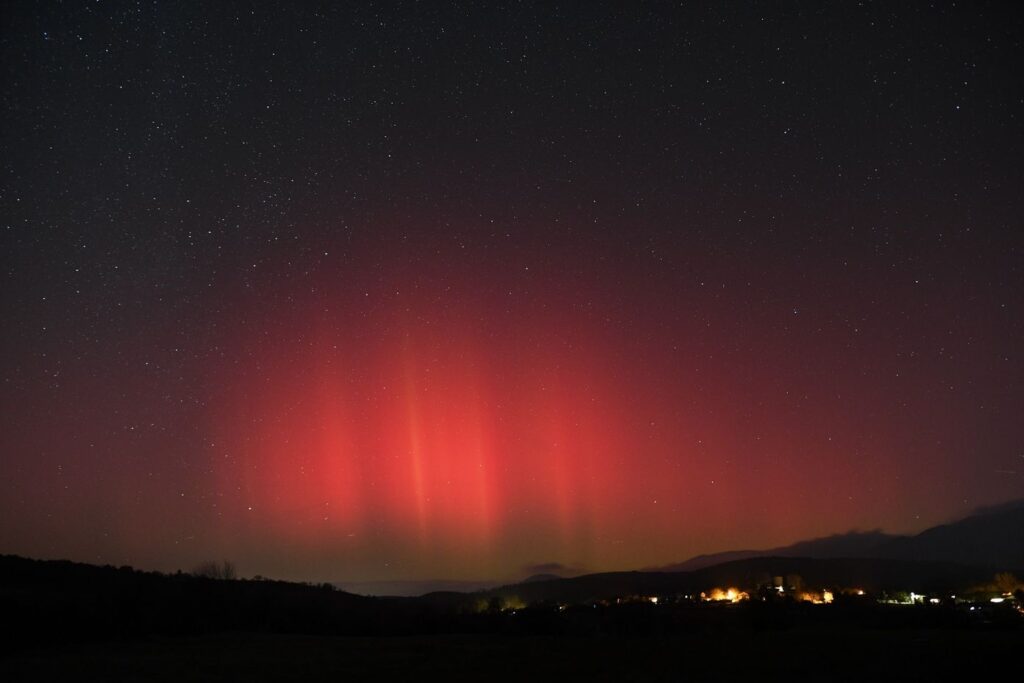
January 18-20, 2026 aurora at DST = -202 nT. Dolenja vas, Slovenia. Photo: Jure Atanackov.
The Great Drought of 2005-2023
Solar Cycle 23 was rich in strong geomagnetic storms and low latitude aurora displays. Its final big, low latitude aurora display was on May 15th, 2005. That was the 17th storm of that cycle that crossed the -200 nT DST index threshold. The active part of Solar Cycle 23 from 1999 to 2005 averaged about three bright low latitude aurora events per year.
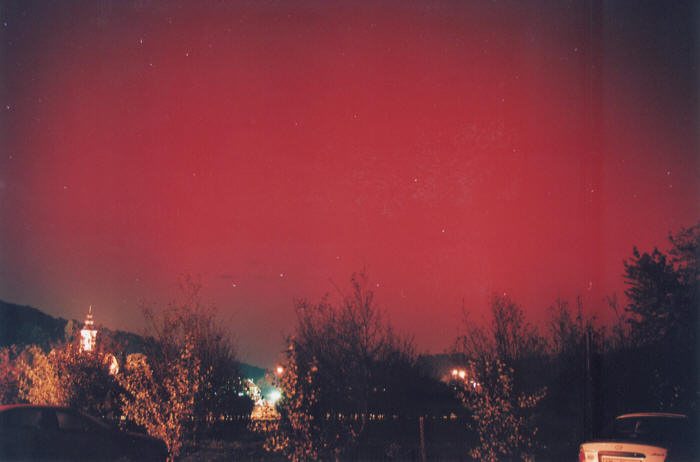
The Great aurora of the 2003 Halloween storms. October 30th, 2003. Kamnica, Slovenia. Photo: Jure Zakrajšek.
Then the long aurora drought began.
Solar Cycle 23 waned until solar minimum in October 2008. When Solar Cycle 24 began, its initial ascent was sluggish. Roughly 36 months in, the cycle stalled entirely. It never truly recovered, rising only slightly to a weak solar maximum 64 months into the cycle (April 2014). It then slowly declined to another deep and prolonged solar minimum in December 2019.
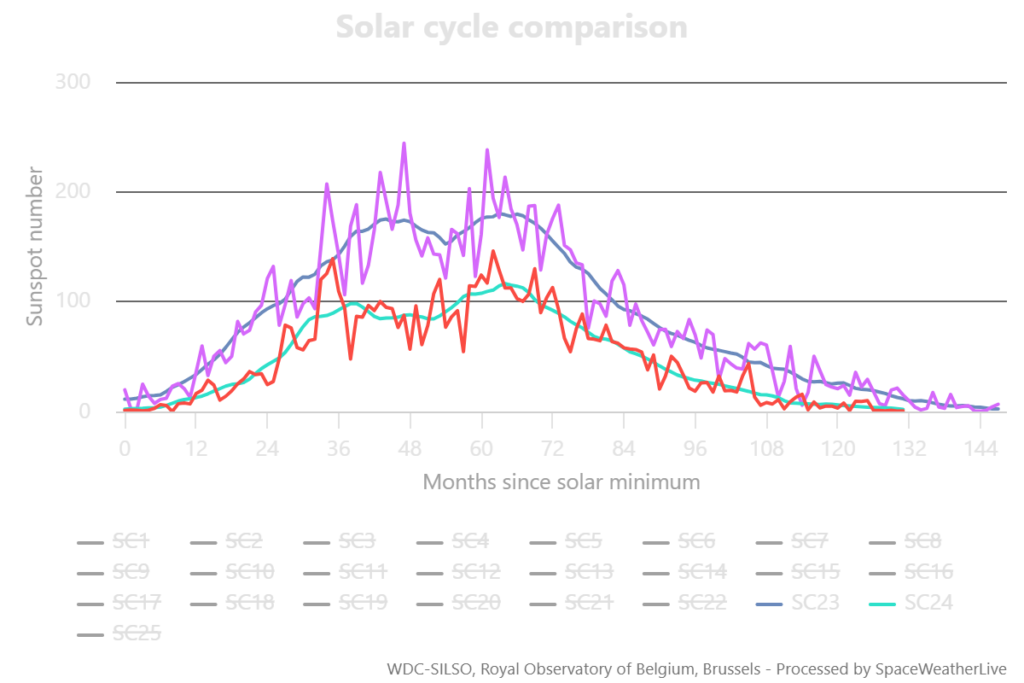
Comparison between Solar Cycles 23 (violet line) and 24 (red line). Plot: Spaceweatherlive.
Solar Cycle 24 became the weakest in a century! And it showed in the auroral activity too. In the entire cycle there was *a single* geomagnetic storm that reached a DST index below -200 nT: the St Patrick’s Day storm on March 17-18th, 2015.
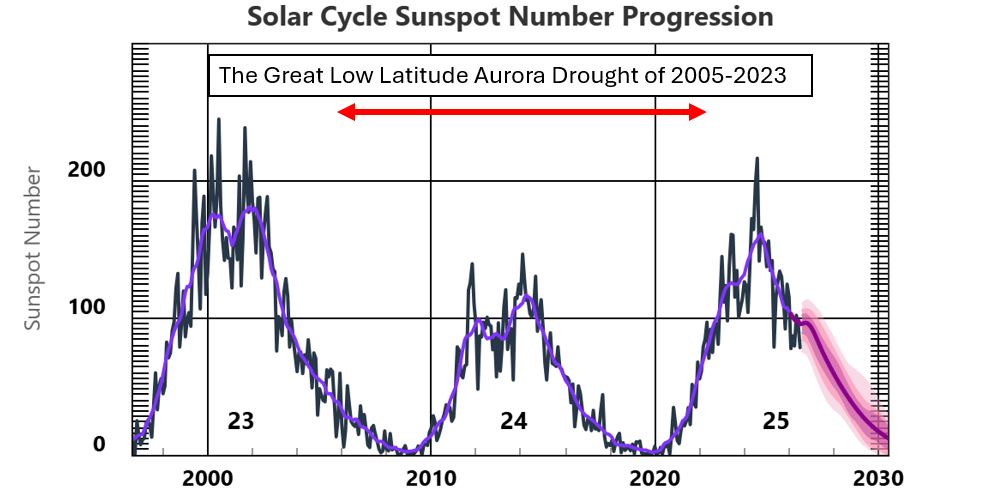
The extended period of virtually no low latitude auroras between 2005 and 2023. Original solar cycle progression plot from the SWPC.
Nearly 18 years passed between the final low latitude aurora display of Solar Cycle 23 and the first one in Solar Cycle 25, with a single isolated event in all that time. This is the Great low latitude aurora drought of 2005-2023.
Solar Cycle 25: the auroras return
By the time Solar Cycle 25 kicked off, an entire generation of skywatchers had grown up having never experienced a major low latitude aurora. The general public had long forgotten the intense auroral displays of the early 2000s.
Activity really picked up in 2023, with the first big (DST < -200 nT) storm happening on April 23-24th, 2023. We also got the 7th largest storm of the Space Age, the 10-11 May 2024 G5 storm. This was the first G5 level storm since October 2003, the first in over 20 years!
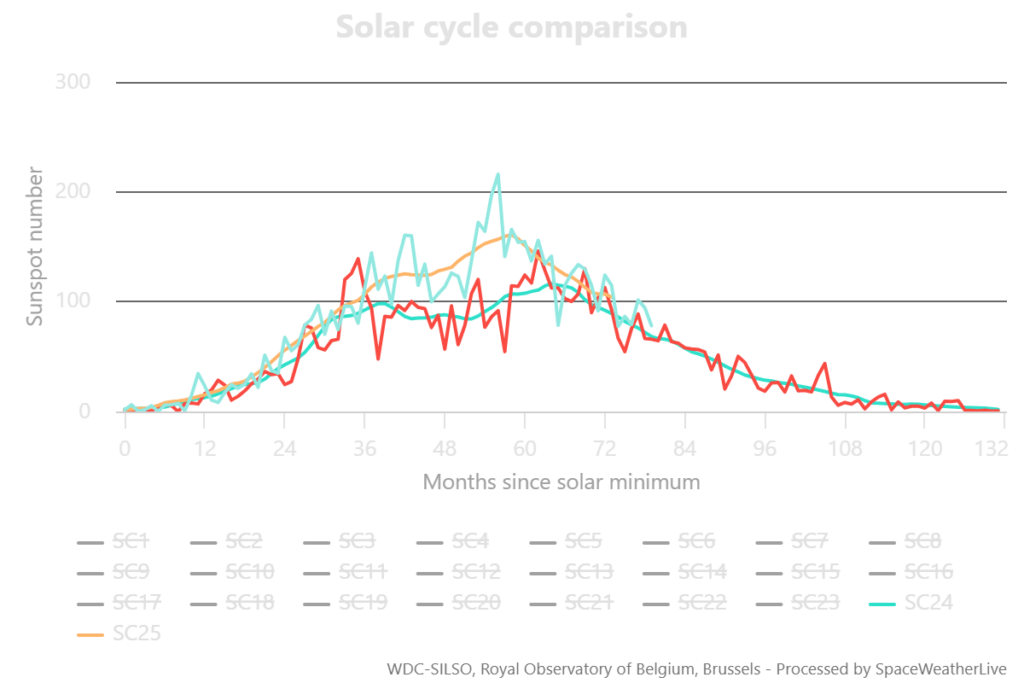
Comparison between Solar Cycles 24 (red line) and 25 (blue line). Plot: Spaceweatherlive.
Solar Cycle 25, while weaker than SC23, has far exceeded SC24. As of today, we have had 6 (DST < -200 nT) storms in Solar Cycle 25. That’s six low latitude aurora events in three years compared to a single event in the preceding 18 years.
Is the drought over?
For now it is. Solar Cycle 25 has delivered average low latitude auroral activity, similar to cycles 20 and 21. It has also been far behind the very active cycles 19, 21, 22 and 23, which produced about 2-5x more low latitude aurora. Compare the 3 low latitude events per year in Solar Cycle 23 to about 2 events per year in Solar Cycle 25 so far.
The (aurora) drought is over, but it isn’t raining that much either. Will the final years of SC25 make up for it? Will the upcoming Solar Cycle 26 bring more low latitude auroras or will we descend into another drought?